
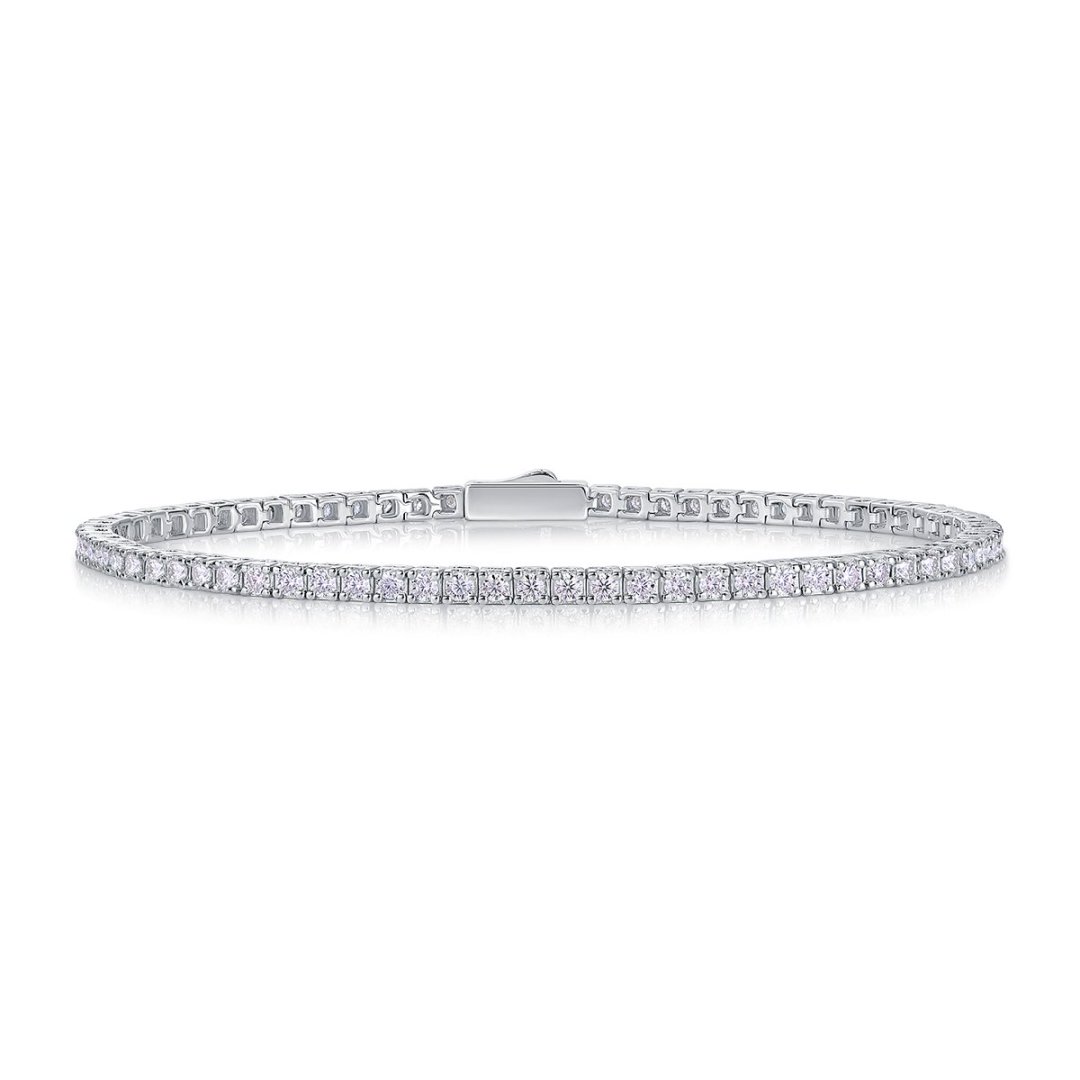
A tennis bracelet should follow your wrist without pinching. It also needs to stay behind the widest part of your hand when you relax your fingers. To find a length, measure the wrist at the place where the bracelet will sit, then compare that measurement with the fit guidance for the exact design. If two sizes look possible, use a bracelet you already like as your reference. An articulated tennis bracelet with a box clasp can feel different from a fine chain of the same listed length.
Measure the wrist at the place you intend to wear it
Use a soft measuring tape and rest your hand on a table with your fingers relaxed. Wrap the tape around the wrist where you want the center of the bracelet to rest. Keep the tape flat and bring the ends together without squeezing the skin. Write down the reading as a wrist circumference. If you move the tape toward the hand or up the forearm, you may get a different reading. That is useful if you are trying to fit a bracelet on a particular side of your watch.
If you have no soft tape, use a narrow paper strip. Wrap it around the wrist, mark exactly where it overlaps, flatten it, and measure from the starting edge to the mark with a ruler. A wide strip can bridge the contours of the wrist and give a different result, particularly near the wrist bone. Check the reading twice. If you are measuring for a gift and can borrow a bracelet the recipient wears, measure that piece separately and tell the seller which number comes from the bracelet and which comes from the wrist.
Measure at a time that reflects the way you usually wear jewelry. If a bracelet tends to feel snug toward the end of the day, make a second measurement at that time. If you are buying a bracelet to wear beside a watch, put the watch on first and check the available space at the intended position. A measurement taken on the bare wrist may still be accurate, but the watch changes where the bracelet sits and how it can move. Write the units on your note so a reading in centimeters does not get mistaken for inches when you compare listings.
Ask how the listing measures length
A listing might give the bracelet’s open end-to-end length, or it might describe the wrist circumference the bracelet is intended to fit. Those measurements answer different questions. A box clasp can have a tongue that slides into the body. Part of that length then overlaps rather than adding room around the wrist. An extender chain may also be counted in the listed maximum length even though it gives the wearer several different positions. Ask the seller to explain the measurement using a photograph of the bracelet beside a ruler if the product description leaves room for doubt.
For a simple comparison, suppose a person measures a six-inch wrist and is looking at bracelets listed at six and a half and seven inches. The labels alone do not establish that the pieces allow half an inch or a full inch of extra room when closed. Ask whether the measurements include the clasp tongue and whether the seller has a recommended wrist range for each size. A longer size may suit someone who likes a moving bracelet, but the shorter size may already provide enough room if the design is flexible and its length is measured in a different way. This example illustrates how to question the label rather than prescribing either length for every six-inch wrist.
If you already have a bracelet with similar links, lay it flat on a soft surface and measure it with the clasp open. Do not stretch it or force a rigid section flat. Identify the points you used, ideally with a photo. Then close it and note how far it moves on your wrist when your hand hangs down. You can send the seller both measurements and ask which size would reproduce that fit most closely. If your reference piece is a fine chain and your candidate uses large stones and a thick clasp, say so. The seller can then take the construction into account instead of matching the same number blindly.
Choose how closely the bracelet should sit
For an everyday fit, look for enough room to bend and straighten the wrist without the links pressing into the skin. A bracelet that sits close often keeps the stone row where you can see it. That can help when you want it to stay in place under the edge of a sleeve. A little more movement can be comfortable if you dislike feeling jewelry against the wrist bone, but check where the clasp lands when the bracelet rotates. On a loose fit, a raised clasp may repeatedly move to the top and a stone row may turn away from view.
A desk test catches problems you might miss while standing in front of a mirror. Rest your forearm as you would while typing and move your hand from side to side. Notice whether the underside of the clasp digs in and whether the stone settings catch the cuff. Then let your hand hang naturally. If the bracelet reaches the broadest part of the hand and starts sliding over it, it may be too loose for the way you intend to wear it. If bending the wrist forces the stones against the skin and leaves a deep impression, try another length or compare a design with a different profile.
For a gift, an exchangeable length is especially valuable if you do not have a reliable measurement. Ask the recipient to measure an existing bracelet if the gift need not be a surprise. When it is a surprise, a photo of an everyday bracelet can help establish the style and relative width, but it cannot measure the inside fit. If you are unsure whether a length can be exchanged, ask before requesting engraving or a custom adjustment. An estimate is easier to correct when the piece is still a standard configuration.
Account for stone width, link movement, and the clasp
Larger stone settings can make a bracelet thicker or change the way its links curve. Two bracelets with identical lengths on a flat ruler may feel different because one bends tightly around the wrist and the other needs more room to turn around its thicker links. Look at the inner side of the bracelet as well as the face. A photo taken with the bracelet resting in a curve is more revealing for this purpose than a straight catalog image. Use the stone-size guide to compare visual scale, then check the finished piece separately for fit.
Also check how much space the closure takes up underneath. A short clasp that follows the chain can feel different from a longer flat housing, even if both fasten securely. When trying the bracelet on, open and close it over a surface that can catch it. Look at the release and any safety arms. They should engage as designed without having to hold the bracelet under tension. If the clasp opens during ordinary movement, stop wearing the piece and have it inspected. Fit changes cannot correct a faulty closure.
If a bracelet will sit next to a watch, consider which side of the watch leaves the most room. Put both pieces on and move your hand through a normal range. A bracelet can look balanced in a still photo and still catch a corner of the watch clasp. The combination may work better with a slightly different position or when worn on opposite wrists. Browse Cristiera’s tennis bracelet collection for examples of different stone and link profiles, then ask about the actual length and closure of the particular model you like.
Decide what to do between sizes
Write down the wrist measurement, the preferred amount of movement, and the location where you want to wear the bracelet. Ask the seller which of the two sizes best matches those preferences on the design you chose. If you can try them, start with the one the seller recommends, then test both with normal movement. A snug fit should not bind. A relaxed fit should still stay securely on the wrist. A model with a shorter connector can make a difference if the numbers are close and the seller offers such an option.
If neither stock size fits, ask how the design can be shortened or made to order. Some articulated styles can be adjusted by removing links, while other designs need different work because the settings are close to the closure. Request the resulting finished length before authorizing changes. Ask whether spare links can be returned and how the alteration affects exchanges or later repairs. If you are scaling the choice for a retail assortment, order samples in more than one size and record their open and closed measurements before committing to a full run.
Before you place the order, save the measurement instructions or the sizing conversation alongside the SKU and finish. On arrival, verify the bracelet against those instructions and try the fit before removing tags or packaging. If it moves very differently from what you expected, take photos and record the actual measurement using the same endpoints. This lets the seller distinguish a size mismatch from the normal feel of a thicker setting or less flexible link design.
Frequently asked questions
What is the difference between bracelet size and stone size?
Bracelet size normally refers to length or the wrist size it is meant to fit. Stone size describes an individual stone’s dimensions. Ask for both if you are comparing styles, because a bigger stone may change the feel of the finished bracelet.
Is it better to size up when I am between lengths?
Ask how the bracelet is measured and how it bends around the wrist. Size up if the shorter option would restrict ordinary movement and the longer one stays behind the widest part of your hand. Checking the exact model is more useful than using one rule for every design.
Should the tennis bracelet spin around my wrist?
A relaxed fit can move naturally. If it constantly turns and puts the clasp on top when you prefer the stone row there, try a closer fit or a model whose closure and links sit differently.
Do I measure above or below the wrist bone?
Measure where the bracelet will actually sit. If you wear it on different sides of the wrist bone depending on whether you have a watch on, record both measurements and tell the seller which position matters most.
Can a bracelet fit tightly even when its listed length is longer than my wrist?
Yes. Some of the listed length can overlap at the clasp, and thicker or less flexible links can affect the usable space. Ask for the manufacturer’s measurement method and wrist-fit guidance.
Can I measure with a piece of string?
Yes, if it does not stretch. Mark the overlap, lay it flat without pulling, and measure it against a ruler. A narrow paper strip can be easier to mark and can help you avoid inadvertently stretching the string.