
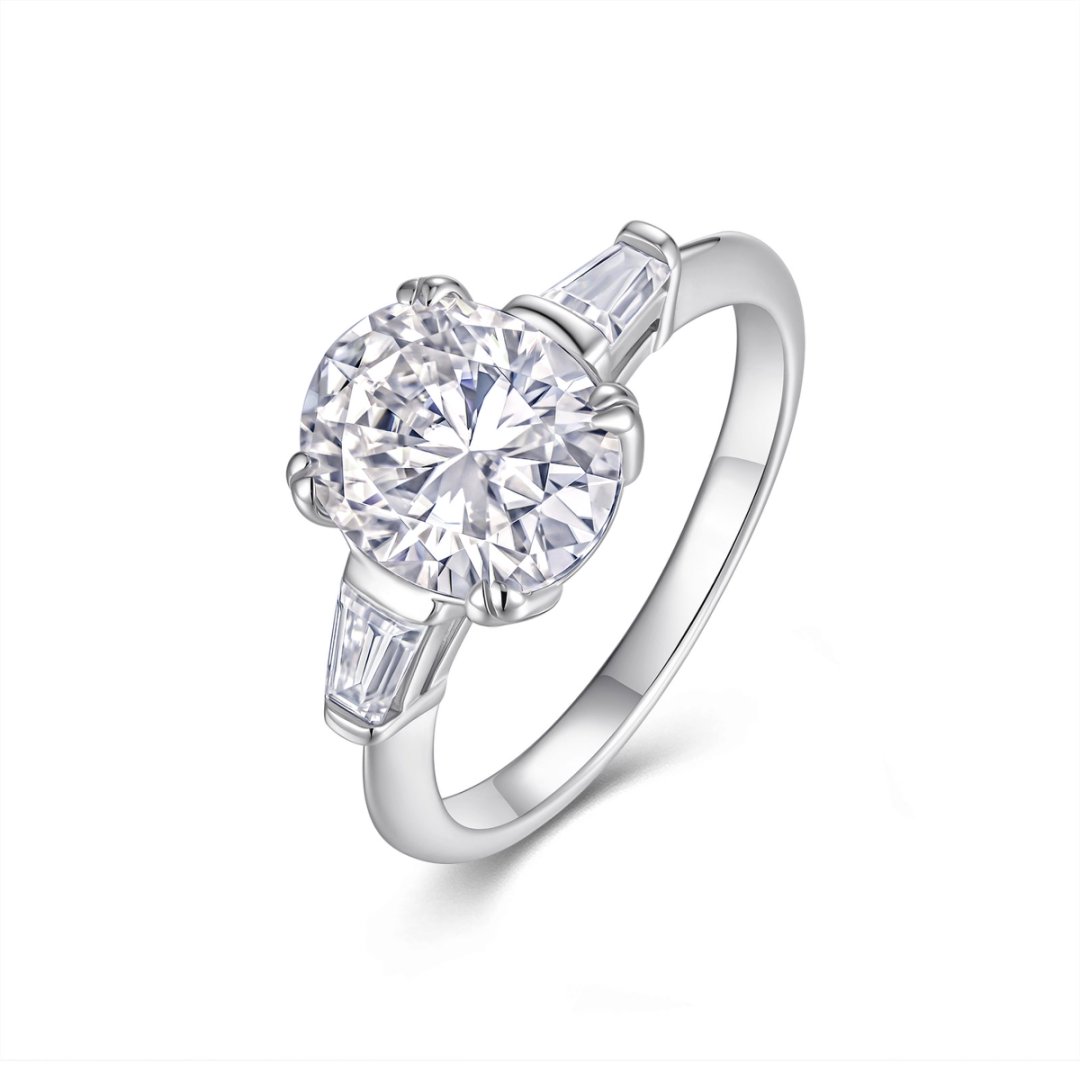
Yes, a moissanite ring can be a practical engagement ring for someone who enjoys its lively flashes of color and wants to put more of the budget into the setting or overall design. Start with how the ring will actually be worn. A person who pulls on knit sleeves every morning and wears a straight wedding band has different priorities from someone who wants a large center stone with an open side profile. Choosing the mounting with those habits in mind is what makes the ring feel right after the proposal.
Start with what the wearer likes in ordinary light
Moissanite and diamond are distinct gemstones. If you are considering both, compare similar outlines and face-up sizes under a window, under ordinary indoor light, and at arm’s length. A video made under a bright spotlight shows one situation. It can hide what the stone looks like at a desk or in a room with soft lighting. Many people actively like the colored flashes moissanite can show. Others want the particular appearance of a diamond because that is what they pictured wearing. Either preference can guide the purchase. If you are buying as a surprise and the recipient has mentioned a specific gemstone, take that preference seriously.
A good starting exercise is to compare a round and an elongated stone in the same type of setting. Look at the ring beside an ordinary band and notice whether you like the amount of finger coverage. Then look down at the ring while holding something, such as a mug. Do you notice the outline first, or the sparkle? A simple round solitaire puts the emphasis on the center stone. A longer outline changes the proportions of the ring, especially when the band is narrow. If you can only shop online, ask for a straight overhead image on a hand and a side view under ordinary light. Use the same viewing distance for both candidates so the larger image does not make one ring look bigger than it really is.
Choose the setting for the wearer’s routine
For someone who regularly wears gloves or prefers low jewelry, begin with a low profile and an even, smooth perimeter. A bezel is one option. A low prong basket with smooth tips can also work. Ask how far the setting rises above the finger and look for any parts that extend sharply past the shoulders. The name of the setting only describes how it holds the stone. A jeweler can build a tall bezel or a low prong mounting. Compare the side profiles before you decide which is a better fit. See the guide to prong and bezel settings for details on what each structure exposes.
If a straight wedding band matters, ask the seller to photograph it against the exact engagement ring. Check whether the gallery or shoulders obstruct the band. A ring with clearance beneath the head may stack neatly, while a low center setting can produce a gap or call for a contoured band. Some wearers like that small gap. If the recipient is particular about the two rings meeting, confirm it at the design stage. Ask for both a top view and a side view so the photo shows whether the bands touch the stone setting. Two rings can look flush in one photo and make contact at a vulnerable point underneath.
For someone who plans to wear the ring mainly at dinners and special occasions, more open space around the stone or a higher mounting may be an acceptable trade-off. If you want the ring to be comfortable almost every day, check the underside, the edges of the band, and where the ring contacts the fingers next to it. Choose the design that fits the intended use. Taking the ring off for activities that put force on its setting also makes sense regardless of the center stone.
Budget for the complete ring
A ring quote should clarify the stone, base metal, finish, setting, ring size, and any custom work. Ask for the cost of the finished ring at the size you plan to order. A starting price can describe a smaller stone, another metal, or a standard mounting. Compare quotes with similar measurements and service terms. If one includes sizing or an inspection and another has a separately billed service, take that into account. Check whether shipping and applicable taxes are included before using the numbers to compare two sellers.
Consider where you would spend the next portion of the budget. A wearer who wants a ring to sit comfortably against a wedding band may get more value from an appropriate mounting than from another increment in stone size. Someone who cares about a certain silhouette may prefer to pay for shaping the metal around a particular stone. A simple solitaire is a useful reference point because you can see what the band and stone cost together before adding side stones, engraving, or custom details. Browse Cristiera engagement ring designs to identify the shapes you want before asking for a quote.
Read the metal description as carefully as the stone details. If a ring is described as gold plated over sterling silver, the plating is the surface and the silver is the underlying alloy. If the ring will be worn often, ask what service is available for the finish and how repair or resizing would affect it. Ask the same questions about any matching band. Two pieces sold in the same color can have different underlying metals and service options. Choose based on the specifications of the particular rings you intend to wear together.
Use millimeters to judge the center stone
Write down the stone width in millimeters. For an oval or other elongated shape, record length and width. A listing that uses a diamond-equivalent figure describes a comparison with diamond size and should also provide actual dimensions. Face-up measurements let you compare stones across different outlines. They also help you see how much of the finger the finished setting may cover. The setting can be wider than the stone, particularly when a rim or side stones surround it, so ask for the finished head width too if coverage is important.
Here is an example. Suppose you are deciding between a round solitaire and an oval that appears to have a similar size in two listings. Cut two paper shapes to the advertised dimensions and hold them over the finger. Note how the ends of the oval sit relative to the knuckle and how much open space remains on either side. The paper does not reproduce depth or sparkle, but it is good for deciding whether the outline makes sense. Once you have a preferred width, look at a side photo to decide whether that size works with the height of the mounting.
The wearer’s finger size also affects the impression of scale. A stone that looks understated on one hand can cover a substantial part of another. If the seller can supply photos on hands of a known ring size, look for one reasonably close to the recipient’s. Ask whether resizing is possible, particularly for a ring with engraving, stones along the band, or a pattern that goes all the way around. If the size is uncertain, see how to measure ring size at home before ordering.
Make the order easy to verify
Before ordering, save the model name, the agreed stone dimensions, the metal and finish, and the ring size. For a custom design, add an approved drawing or photographs of the design you discussed. Mark the details that matter most, such as how low the head should sit or whether it needs to accommodate a straight band. If it is a gift, check when exchanges can be requested and whether engraving or a custom size changes the terms. If you are working toward a proposal date, confirm the estimated completion and delivery separately so you have time for a fit check.
On arrival, inspect the ring in soft daylight. Compare the stone outline and band finish with the order description. Check that the ring sits comfortably and can be removed without force. If you notice movement in the stone, a new gap, or a setting that catches more sharply than expected, set the ring aside and contact the seller about inspection. Photograph the concern from the front and side. A jeweler can assess the mounting without you having to pry or press the metal yourself.
For a proposal where the recipient would rather choose together, consider browsing designs together beforehand and leaving one detail, such as engraving, for later. You can still keep the timing of the proposal a surprise. If you plan to choose the whole ring yourself, base the decision on jewelry the recipient already wears and any preferences they have shared. That is a better guide than a generic claim about what an engagement ring ought to look like.
Frequently asked questions
Is moissanite suitable for a ring worn every day?
It can be a good option. Give equal attention to the mounting and band. A smooth profile, good fit, and a setting that suits normal activities are more useful than choosing by gemstone alone.
Does a moissanite engagement ring look like a diamond ring?
A similar cut and setting can give the rings a similar silhouette, but the stones have different optical appearances. Compare them under ordinary indoor light and daylight before choosing. A spotlight video mainly shows what happens under concentrated light.
Is a bezel always better for an active wearer?
Consider a smooth bezel or a low prong design. Check the actual height and any projections around the setting. Remove the ring for work or activities that would put heavy pressure on the band or stone.
What stone size should I buy?
Start with the face-up dimensions in millimeters and compare the footprint on the intended finger. Then check the profile height and the finished head width. These are more directly useful for fit and appearance than a carat-style label alone.
Can a straight wedding band sit next to it?
That depends on the engagement ring profile. Ask for a photograph of a straight band placed beside the exact mounting. If clearance is limited, decide whether a gap, contoured band, or different mounting fits the wearer’s preference.
What should an online seller confirm before I pay?
Ask for the stone identity and dimensions, ring size, base metal, surface finish, mounting profile, and the exchange or resizing terms. For a custom order, save the final design details and the estimated completion date together.