
Contents
- Start with what you want people to notice
- Choose a pendant or a line of stones
- Use your neckline to pick the chain length
- Read the metal and stone specifications separately
- Make the final choice with one practical test
- Frequently asked questions
Start with what you want people to notice
If you want one bright point that works with the clothes you already wear, start with a solitaire pendant. If you want the necklace to frame your neckline even from across the room, look at a tennis necklace. A shaped pendant is a good middle ground when the outline matters as much as the stone. A heart, cross, or V can give a simple outfit a distinct focal point without adding a full row of stones.
Picture the last three tops you wore. If two had high crew necks, a short pendant may disappear under the collar or sit right on its edge. You can either go shorter so it sits against skin or longer so it rests clearly over the fabric. For an open collar, a small pendant can sit inside the opening, while a longer chain may drop below it. Try a necklace you already own with those tops before ordering. A length that works with a low neckline may look awkward against the seam of a high one even if it feels perfectly comfortable.
The same test helps when the necklace is a gift. If the recipient wears small studs or a plain watch, a compact pendant is an easy place to start. If they routinely wear graphic jewelry or structured jackets, a square stone or a sharper pendant outline may feel more like something they picked themselves. Look at pieces they wear repeatedly and borrow the scale or shape from those, particularly when you cannot ask them directly.
Choose a pendant or a line of stones
| Style | What you see first | Check before ordering |
|---|---|---|
| Solitaire pendant | One center stone and a visible chain | Stone dimensions, pendant height including bail, and chain length |
| Shaped pendant | A recognizable outline such as a heart or V | Overall width, how it hangs, and whether it is fixed to the chain |
| Tennis necklace | A row of stones tracing the neckline | Finished width, length, clasp, and how the links lie when worn |
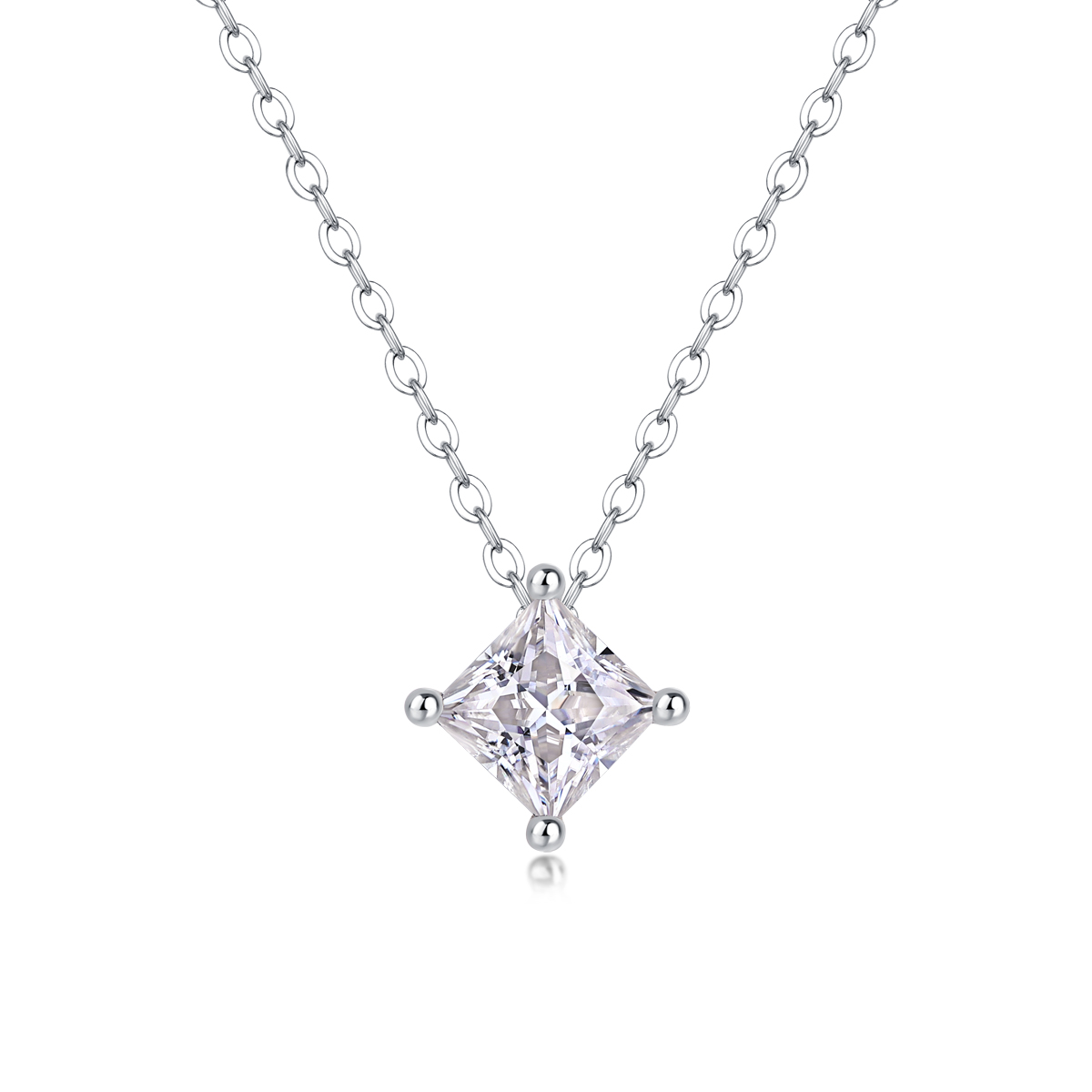
A square solitaire gives you a geometric outline in a small area. The Cristiera square moissanite necklace is an example to look at if you like a clearly defined center. Compare the full necklace photo with the close-up. The close-up helps you see the setting. The full view tells you how much of the necklace’s visual weight sits in the pendant. That distinction matters when you are choosing an everyday piece from a product photo where the pendant takes up the whole screen.
A shaped pendant can be more expressive at a similar scale. A V repeats the lines of a V-neck, while a rounded shape can soften a plain crew neck or a button-down shirt. Look through the Cristiera necklace collection to compare the outlines. If a pendant is fixed at both sides, the chain and pendant behave as one piece. A pendant that slides on the chain can move as you turn or bend. Ask how the specific design is assembled if you want to swap chains later.
With a tennis necklace, check the curve along the front. A uniform row is useful when you want the same visual weight across the neckline. Graduated designs concentrate more of that weight toward the center. Ask for a worn image or a short video if you are concerned about twisting or how the necklace sits near the collarbone. A photograph of the piece laid straight shows the pattern, but it cannot tell you how articulated links behave around a curved neck.
Use your neckline to pick the chain length
Measure the necklace you already wear most often. Open the clasp, lay it flat, and measure the full usable length in inches. Put it on with the top you have in mind and note where the chain and pendant fall. If you want the pendant below a neckline seam, place a piece of string at that height and see how much extra length you need. Compare your result with the seller’s measurements. A necklace listed with an extender may use the shortest length or the maximum length as its headline figure.
The difference between 16 and 18 inches is two inches around the full chain. Where that difference appears on the front depends on neck circumference, the shape of the chain, and the pendant. A fixed pendant can sit differently from a freely sliding one. A taller pendant extends farther down than a small round one on the same chain. Measure from the top of the bail to the bottom of the pendant if a listing provides both parts separately. The 16 vs. 18 inch necklace guide goes into more detail on how to compare those lengths.
For layering, try the shorter necklace first and adjust the longer one so their focal points stay separate when you move. Two necklaces can have visibly different chain lengths yet still land in the same place if one has a taller pendant. Walk a few steps or put on your jacket before deciding whether the spacing works. If the pendants meet every time you turn your head, shift one chain to another extender link or choose a different pairing. A visible gap in the mirror is most useful when it survives normal movement.
For a gift, an extender is useful when the recipient likes to alternate between open and closed necklines. Ask what the shortest and longest wearable settings are and confirm that the pendant hangs the way you want at both lengths. A chain with several usable points offers more flexibility than one with a single fixed setting, provided the clasp is comfortable to use on each link.
Read the metal and stone specifications separately
The listing should tell you what the chain is made of, what metal holds the stone, and what finish is on the surface. Sterling silver is an alloy containing 92.5 percent silver. A description such as silver tone identifies an appearance, and silver plated describes a surface treatment. If the listing mentions 925 silver in the title, check whether that applies to the chain, the pendant setting, or both. The distinction matters if you want to replace a chain later or if you are comparing two necklaces that look identical in the photos.
Check the plating separately when the product is sold with a gold-colored or bright white finish. A seller should be able to identify the base metal and state whether a surface coating is used. If those details are missing, ask a short question that names the parts you care about: what are the chain and pendant setting made of, and are either of them plated? This also gives you something concrete to refer to when you read the cleaning instructions. A polishing method suitable for one finish may be unsuitable for another.
Read the stone dimensions in millimeters before relying on a carat-style description. A listing may use a diamond-equivalent size, which expresses how the stone compares visually with a diamond of a stated weight. Two stones marketed with a similar equivalent size can have different outlines and dimensions, particularly if one is round and the other is elongated. For a square or rectangular pendant, look for both the length and the width. Then check the dimensions of the finished pendant so you can account for the metal around the stone and the bail above it.
If you want to compare two listings, write their specifications next to each other on one line each. Include the chain length range, pendant dimensions, metal for both components, finish, and clasp. Any blank field is a question to ask before paying. It is much easier to compare a specific unanswered question than to decide which listing looks more reassuring overall. Check the exchange terms as well if you are ordering a gift or choosing between lengths you cannot try on in person.
Make the final choice with one practical test
For an everyday necklace, put on your usual top and jacket and decide whether you want the pendant against skin or over fabric. Look for a piece that lands in one of those places clearly. A necklace that repeatedly falls under the collar may spend more time hidden than you expect. If you like a simple bright detail, a square or round solitaire is a useful first comparison. If you want the necklace to do most of the styling, compare a distinctive pendant with a tennis design and decide whether you prefer a focal point or a continuous line.
For a necklace you will wear with other jewelry, use the piece you already own as the starting point. A broad chain may leave little room for another piece close to the neck. A small pendant on a longer chain can give a shorter necklace its own space, provided the pendant does not repeatedly catch the other chain. Try the combination under normal light and see how it looks at conversation distance. You can leave more space between the pieces when you want both to show distinctly.
For a gift, prioritize a familiar metal color, a length with some room to adjust, and a style the recipient can wear with clothes they already own. If you are uncertain about the exact design, use a single photo of their usual jewelry to compare the scale of the piece. A pendant that seems tiny on a screen may be exactly right for someone whose favorite necklace is barely wider than the chain. A more substantial piece makes sense when they already reach for visible jewelry on ordinary days.
Once you have a shortlist, check the same details on each product page and ask for anything essential that is missing. The best comparison uses the actual model, available length, and finish you intend to order. That lets you choose based on how the necklace will fit into your wardrobe and know what to expect when you open the box.
Frequently asked questions
What is the easiest moissanite necklace to wear every day? A small solitaire is a practical starting point if you want a single highlight and already wear simple jewelry. Check how the pendant sits with your usual neckline. A short necklace can work beautifully with an open collar and spend much of the day hidden under a higher one.
Does a 925 stamp tell me what the whole necklace is made of? Check which component carries the mark and read the written specifications for the other parts. The chain and pendant can be supplied separately, and a surface finish is a separate detail from the base metal.
How do I compare pendant size from photos? Use the stated millimeter dimensions and cut a piece of paper to roughly that outline. Hold it at the place where the necklace would sit. Ask whether the listed dimensions include the bail or only the pendant body. For an accurate comparison, check the chain in the full product view as well.
Is a tennis necklace a good first purchase? It can be if you want a visible row of stones and already know which length works with your wardrobe. Ask for a worn view, the finished width and the clasp type. If you want something that can move between outfits with little thought, compare it with a small pendant before ordering.