
Pick up a necklace by its clasp and watch what the pendant does. If the chain travels through a loop or opening above the stone, the pendant can slide along it. If chain segments attach to the setting on either side, the center stays at a defined point on the necklace. This small construction detail determines whether you can switch chains, how the pendant moves as you turn your head, and what needs attention if one part is damaged. Two moissanite necklaces that look almost identical from the front can behave very differently in the hand.
There are really two questions to ask. Can the pendant move along the chain? And can it come off the chain without opening a metal fitting? The answers need not be the same. A sliding pendant can be permanently captured between two ends that are too large to pass through its opening. That distinction matters if you are buying a pendant to wear on a chain you already own.
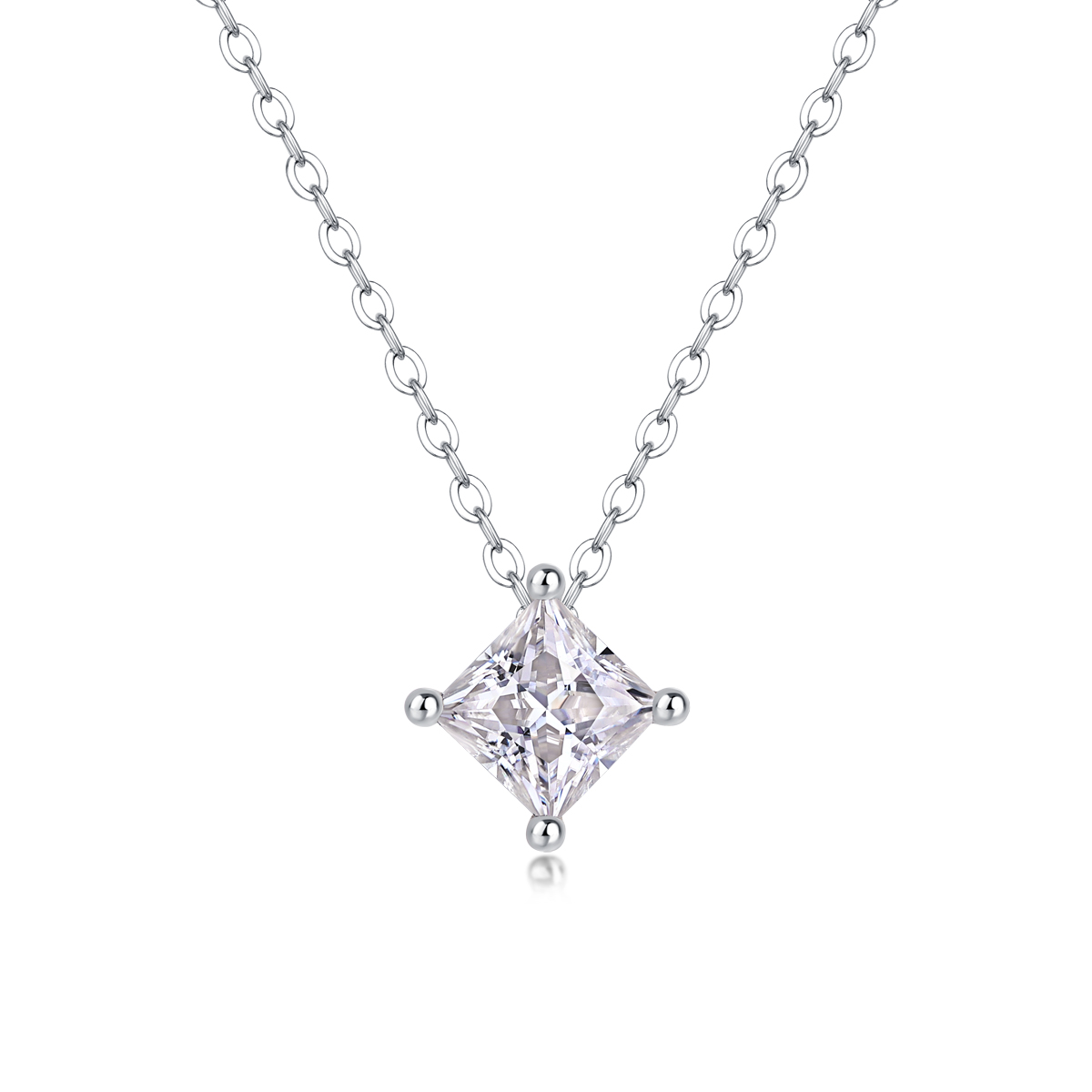
Follow the chain behind the stone
Look first for a visible bail, the loop that joins a pendant to its chain. It might be a simple tapered loop standing above the center or a decorative element that forms part of the outline. Follow the chain into one side of that loop and out the other. From the front, the bail adds visible height above the stone. From the side, its internal opening determines how much room the chain has to pass through and change angle as the necklace settles.
A hidden bail can give a similar sliding action without a separate loop showing above the stone. The chain passes through a channel or openings at the back. The pendant may therefore appear to float on the chain. Floating describes a visual effect, and sellers use it for different constructions. Ask for a clear photograph of the back before concluding that the piece is removable, fixed or able to slide. A shadow under a photographed pendant can make a substantial rear channel almost invisible.
On a fixed necklace, follow the chain to the two points where it meets the setting. You may see small rings, short articulated sections or attachments incorporated into the sides. The setting itself forms a link in the necklace. A retailer may call the center a station, although that word can also describe one of several motifs spaced along a chain. A close photograph of the joints and the complete laid-out necklace usually resolves the terminology in a single exchange.
A moving pendant can still be captive
Consider a fine chain whose links pass freely through a rear opening. At the clasp end is a wider tag. At the other end is a fastening ring. If neither end will pass through the opening, the stone can travel from side to side but the pendant stays on that chain. This is perfectly serviceable construction. It becomes a problem only when a listing leads a shopper to expect the pendant to fit several existing necklaces.
The relevant measurement is the shape of the largest fitting that actually has to pass through the bail at the chosen end. A flat tag might turn sideways inside one opening and jam in another of similar apparent width. The hole itself can also narrow inside a decorative loop. If a seller can demonstrate removal and replacement on the supplied chain, that answers the question for that combination. It does not prove that a chain with a different end fitting will also pass.
If matching an heirloom chain, take the chain to the shop or send measurements and photographs with a ruler in the same plane. Ask for the clear opening, its shape and whether the maker recommends that chain style with the pendant. Our guide to choosing a pendant chain explains the compatibility check. Avoid opening a soldered ring or squeezing a tag at home to make an uncertain combination fit.
| Construction | Movement | Chain replacement |
|---|---|---|
| Visible bail | Can slide along a compatible chain | Check both terminal fittings |
| Hidden channel | Depends on channel shape and clearance | Confirm the free opening at its narrowest point |
| Fixed side attachments | Center travels with the necklace | Usually requires work on the connections |
The two constructions hang differently
A sliding pendant tends to seek a low point on a freely moving chain. How readily it returns there depends on the shape of the bail, the chain surface, clothing and the angle of the body. A pendant can remain temporarily off center if fabric catches it. Moving the chain gently while the pendant lies flat is a useful observation. A piece that slides on the counter may still behave differently over the seam of a sweater.
A fixed station travels with the chain when the whole necklace rotates. That can help preserve the intended relationship between the setting and its two adjacent chain sections. It does not guarantee a centered pendant throughout the day. If the fastening shifts, the station can shift too. Look at the position after the wearer turns, sits and stands. A display bust with the chain clipped behind it cannot show that movement.
Attachment height influences the visible angle. Two points close to the upper corners can hold a horizontal bar in a different attitude from a single loop above its midpoint. The back of the setting and the weight distribution also matter. When comparing a heart, cross or another directional design, ask to see it hanging under its own weight from the actual chain. A flat lay with the point of a heart deliberately aligned tells you the outline. It tells you much less about where that point will sit in motion.
Compare two necklaces at the same working length
Imagine comparing a fixed round station with a round solitaire on a triangular bail. Both chains are described as 18 inches. On the wearer the visible bottom of the second pendant sits lower. Part of that difference may be the extra drop of the bail. Another part may come from how the seller measured the fixed necklace, including or excluding the center. Request the end-to-end wearable length for each and the vertical distance from the chain path to the lowest edge of the pendant.
Fasten each sample at the position you would actually use. Let the chain settle without touching the front. Look at how much metal is visible above the stone, then check the view from slightly to one side. If you want an especially clean outline, a hidden bail may be appealing. If you like the vertical line of metal connecting chain to stone, a visible bail can be an intentional part of the design. The difference is clearest at the distance from which you normally see jewelry on another person.
Try the same two necklaces against bare skin and over a simple top. A setting that lies comfortably in one situation may tilt against a thicker knit. If you plan to add another strand, our pendant layering guide describes how to check the visible gap. A fixed center keeps its relationship to its own chain, yet a separate second chain is still free to cross it when you lean forward.
What construction means for service and buying
Suppose a customer wants a longer necklace for one evening. With a removable sliding pendant, a compatible longer chain may solve the request in minutes. With a captive or fixed pendant, check for an existing extension or ask whether an appropriate extender can be attached securely. An extender adds length at the back and can affect how the clasp sits. For a permanent change, a jeweler can assess the connections and finish before suggesting a replacement or alteration.
Now imagine a retailer receiving a necklace with one chain section damaged. On a detachable design the pendant can often be isolated while the chain is assessed. On a fixed design the jeweler needs to see the complete necklace, including the undamaged side, to match link style, length and finish. A photograph and stock reference from the original purchase help with that match. If the piece is plated, ask how the repaired area will be finished before accepting a quotation.
For a buying sheet, record the construction in plain language. “Slides on supplied chain, captive at both ends” is more informative than “pendant necklace.” Add the usable length, adjustment points, pendant drop, finish and whether the image represents the quoted variant. When viewing moissanite necklaces, this short description gives sales staff a reliable answer to the customer’s first practical question: can I wear the stone with my own chain tomorrow?
Frequently asked questions
Does a hidden bail always mean the pendant slides?
Inspect the chain path on the reverse. A concealed opening can allow the chain to pass freely, while small attachments concealed behind a setting can hold it fixed. Ask the seller to show the complete back and move the pendant gently on the supplied chain if the construction remains unclear.
Will a fixed pendant stop my clasp moving to the front?
It can change how the necklace balances, but the entire necklace can rotate. Try the exact length on your own neck and over the clothing you wear most often. Note where the clasp and station settle after ordinary movement before choosing the construction to solve a traveling clasp.
Which design is better for a pendant with lettering?
Look for an orientation that remains legible in the intended position. Request a hanging photograph, side view and short movement video. Two attachment points may be useful for a horizontal word, while a single upper loop can work well for a vertical initial. Check the finished piece in motion.
Can a jeweler make a fixed pendant removable?
Sometimes a jeweler can redesign the connections or add a bail. The available metal, finish and support around the stone determine what is feasible. Ask for a proposed drawing and cost before authorizing a change, particularly if it would alter the pendant’s outline or chain length.
What should I measure if I want two chains for one pendant?
Record the internal bail opening and the largest fitting that must pass through it on each chain. Also compare how each chain moves through the opening once fitted. A chain can technically pass through a bail and still feel cramped or hold the pendant at an awkward angle.
What is a good buying choice for a gift?
A removable pendant offers flexibility when the recipient already owns a compatible chain. A complete fixed necklace can be a thoughtful choice for someone who likes a particular stone and chain together. Check the wearable length and exchange terms, then choose the construction that supports the way that person typically wears jewelry.