
Choose a solitaire if the part you love is the uninterrupted outline of one moissanite. Choose a halo if you like a center stone framed by a ring of smaller stones and want that frame to be visible on your hand. The most revealing comparison is between two rings seen at ordinary reading distance, with the center dimensions and the full width of each ring head written down. A close-up can make the tiny gap between a center and its halo look enormous. On your hand the same details may merge into one bright outline.
Try a small thought experiment before opening the product pages. Picture the ring you would draw for a friend on the back of an envelope. Would you draw an oval and two lines for the band? Or would you draw an oval, a rim around it, and then the band? The difference sounds minor, but it tells you which part of a ring you actually see first. That is a good place to start when two attractive designs are competing for the same budget.
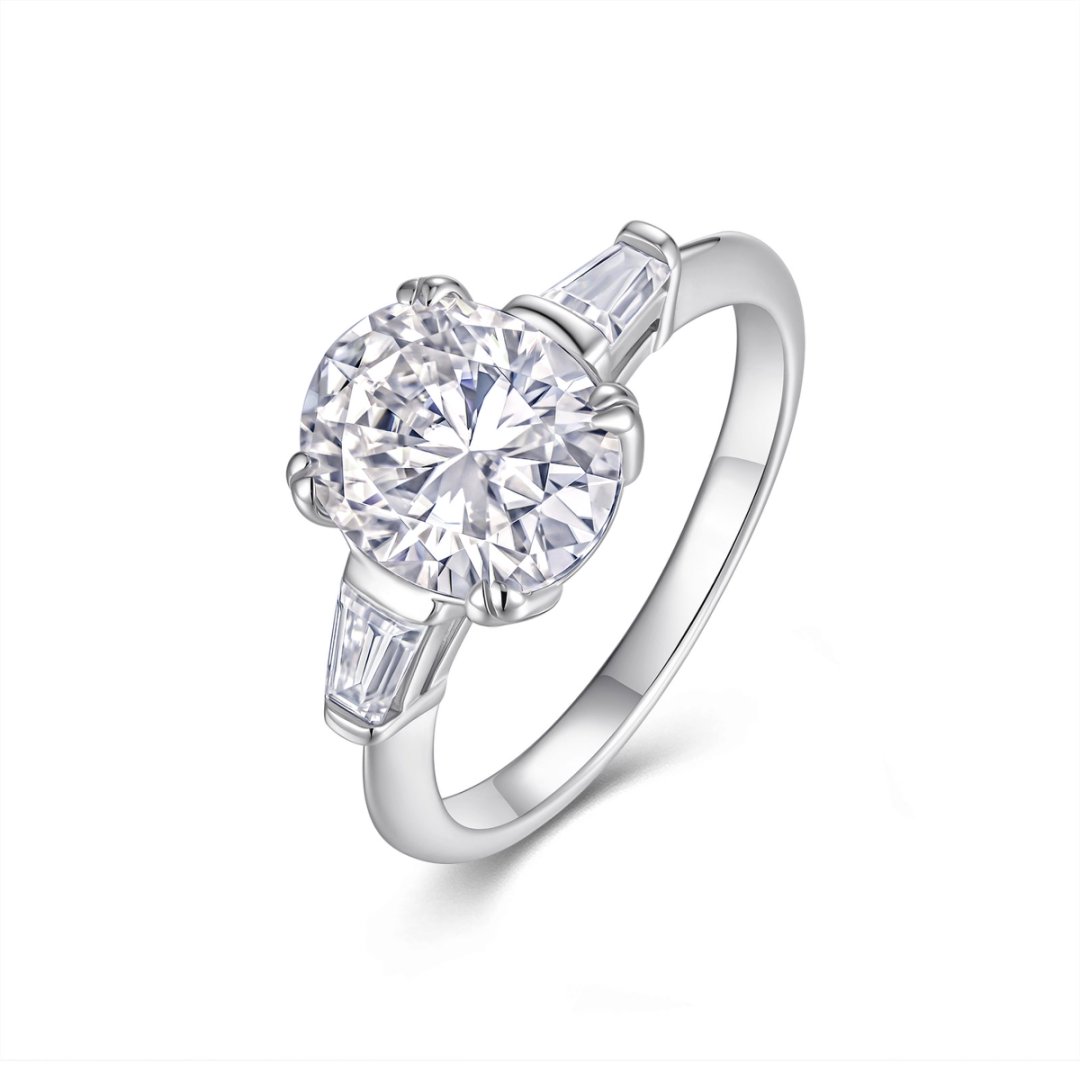
Read the outline before the carat label
A solitaire gives the center stone the starring role. Depending on the design, you may see individual prong tips, a smooth metal border or decorative shoulders. Check what the particular retailer includes under the name. A listing described as a solitaire can still have a decorated band. If you want an entirely plain shank, look at the side photographs or ask whether any accent stones continue down the shoulders.
A face-up halo surrounds the center with smaller stones you can see from above. The spacing and shape of that frame matter. A cushion-shaped halo around a round center produces a soft square outer silhouette. A closely fitted oval halo preserves the long axis of an oval. If you would be disappointed to lose the shape of the center, look for a photo that lets you trace both outlines with your eye. A hidden halo sits below the center and can read much more like a solitaire from above.
Ask the seller to separate three figures: center stone dimensions, outside dimensions of the complete head and the width of the band. A total stone weight might include every accent. It cannot tell you how wide the ring looks across your finger. Our guide to moissanite measurements explains how to read a millimeter figure alongside a diamond equivalent weight when comparing listings.
Make two fair comparisons on your own hand
The first comparison keeps the center size constant. Suppose both options have a round center 6.5 mm across. A face-up halo will extend beyond that center, while the solitaire shows mostly the stone and its surrounding metal. Ask for the finished outside dimensions of both. Sketch those outlines at actual size on paper and set them on your finger. Leave the outline of the center visible in the halo sketch. Looking at that little drawing from arm’s length gives you an idea of how much of the overall ring is frame.
The second comparison keeps the finished width roughly constant. Imagine a halo with a smaller center and a solitaire with a larger center, both measuring about 9 mm across the finished head. From across a room the two might have similar presence. Close up, one offers a broad single face with a distinct edge and the other gives you a pattern of smaller reflections around a central shape. Ask yourself which detail you want to enjoy while looking down at your own hand during an ordinary afternoon.
A try-on matters most if the shapes differ. Place both samples on the intended finger in turn. Look straight down, then relax your arm and look in a mirror. Take one picture of each from the same distance without changing the zoom. Record the ring size used for each sample. A loose display ring that slips toward the side of your finger can make the head appear heavier or less centered than it would be in the correct size.
| Compare | Hold constant | What the trial reveals |
|---|---|---|
| Center size | Center length and width | Coverage added by the halo |
| Finished head | Outer width and length | How much of the outline is one stone |
| Wearability | Finger, clothing and companion band | Contact points during ordinary movement |
See what the top photograph leaves out
Raise your hand to eye level. How high does the head sit, and how far do its edges project beyond the band? One low-set halo might feel easier under a sleeve than a tall solitaire. Another halo might sit on a wide raised basket that regularly meets the edge of a pocket. Look at the actual mounting before assuming either style will suit a job, a favorite sweater or the way you hold a bag. Our ring profile guide shows where to look in the side view.
If you already wear a band on the same finger, take it to the appointment. A thin shop sample can slide under a setting even when your own band meets the lower basket. Look from above for the gap and from the side for the point of contact. A gap can look intentional and may be entirely acceptable to you. Pressure against the delicate edge of a setting is something to discuss with a jeweler before making the pair a daily combination.
Give your hands a minute to move. Reach into a roomy coat pocket, hold a phone, and bend your fingers around a cup. Stop if a setting catches rather than pulling it through the fabric. The question is whether a particular ring works with your usual movements. An uncomfortable edge on the sample merits inspection even if the seller describes that whole collection as suitable for everyday wear.
Decide where the budget should show
A larger number on the tag can come from a larger center, more accent stones, a heavier mounting or quite different materials. Request the center dimensions, setting metal, finish and relevant service terms for each quote. For a halo, ask how accent replacement is handled and whether the design uses stones that are easy for the seller to match. For a solitaire, ask about inspection of the center setting and what happens if a prong needs attention. Obtain a written answer if a service promise is part of your decision.
Picture a buyer who loves the look of a broad oval but has a fixed budget. She tries a larger oval solitaire beside a smaller oval with a delicate halo. The second ring looks generous on her finger, yet the first has the long, calm outline she liked in her reference photograph. If she keeps pointing to the center alone, spending on the frame may leave her wishing for a different ring. If she likes the way the outer stones outline the oval in soft light, the smaller center may be exactly right for her.
Try both away from the brightest display lamp. Look at the rings near a window and then at an ordinary indoor table. A halo can create many little points of reflection, while a solitaire can make it easier to follow the pattern across a single stone. Neither effect comes with a guarantee about which will look brighter to your eyes. Phone videos help most when both rings move together under the same light at the same distance from the camera.
Shop for the person who will wear it
For a surprise purchase, look at the jewelry the recipient already reaches for. A person with one bold geometric ring and otherwise quiet jewelry may love a large solitaire. Someone who collects small intricate earrings might enjoy the detail around a halo even if both people describe their style as simple. Use a specific piece they wear as your reference. Words such as classic and glamorous can mean very different things to two people looking at the same tray.
If you buy online, compare the exact selected variants in the ring collection. Ask for one face-up and one side view, then confirm that the photographs show the center size in your cart. Save the specifications with the order. Before adding engraving or choosing a custom finish, check whether those changes affect exchanges. A surprise is easier to enjoy when the recipient can resolve a fit question without also giving up the option to choose the other silhouette.
Frequently asked questions
Does a halo make the center moissanite bigger?
The frame increases the outside dimensions of the ring head. The center keeps its own measured length and width. If you want more finger coverage, compare the complete heads. If what you love is a broad uninterrupted face, compare the centers separately. Both measurements belong in a useful product description.
Can a solitaire have stones on the band?
Retailers sometimes use solitaire to describe the prominent single center while offering decorated shoulders. Read the details and inspect the entire band. If you want a ring with only one stone anywhere in the mounting, ask the seller that exact question before selecting a variant.
Which style is easier to clean?
Access to the underside and the number of small recesses matter. A plain solitaire with an accessible basket may be straightforward to inspect, while a detailed halo can have more places that collect residue. Follow the care directions for the metal and finish of the particular ring.
Does a halo always cost more than a solitaire?
Compare finished rings with a defined center size, metal and construction. A larger solitaire can cost more than a halo with a smaller center, and the amount of setting work can change the comparison again. Ask for itemized specifications before interpreting the difference in the two prices.
Will a straight wedding band fit beside a halo?
It depends on the clearance beneath the head and the thickness of the wedding band. Try the actual pair together and check where they meet as the rings rotate. A low basket can stop a straight band before the shanks touch, even when the top looks neatly matched.
What is the easiest way to choose between two finalists?
Photograph both on the same hand at the same scale and look again the next day. Write down which detail you remember without looking at the pictures. Then check comfort, pairing and return terms on that finalist. A choice grounded in one detail you love tends to be easier to explain than a choice based on a label.