
The right chain for a moissanite pendant has to do three jobs. Its end fittings must pass through the bail, its construction must suit the pendant, and its length must put the necklace where you want to wear it. Start with those checks, then choose the pattern and finish you like. A chain can look beautifully balanced in a photograph and still arrive with an end ring that cannot pass through the pendant.
If you already own the pendant, keep it beside you while you compare chains. If you are buying both pieces, ask the seller to confirm that the finished chain and pendant have been tried together. “Chain included” is useful information, but it leaves several fit and construction questions unanswered.
Check the Bail and the Finished Chain Ends
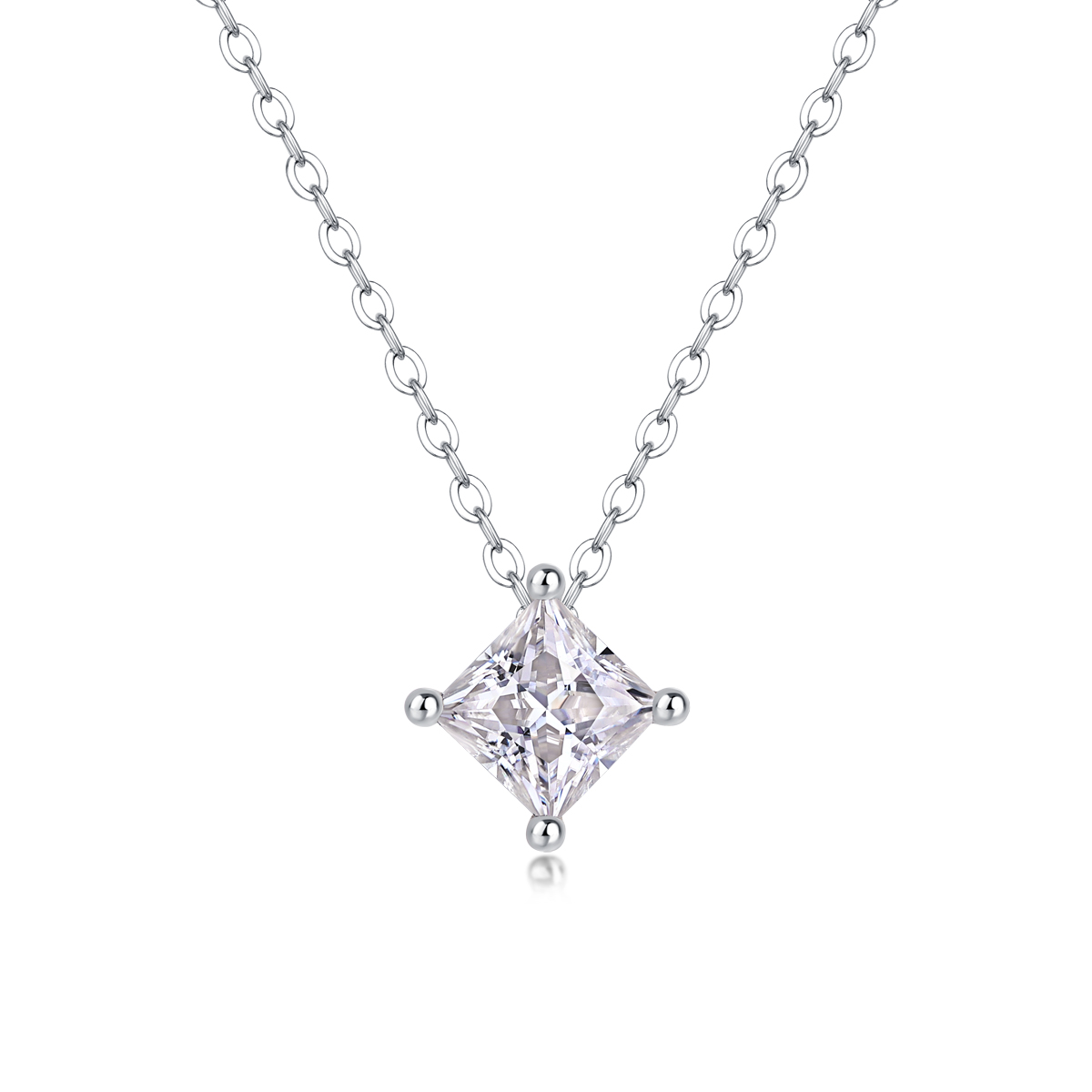
The bail is the loop or passage through which the chain runs. Some pendants have a visible bail above the stone. Others hide the passage behind the setting. Look for the usable inside dimensions at the narrowest point. The outside width of a decorative bail tells you little about the opening available for a chain. For a hidden passage, ask for a photograph showing its entrance and exit.
Compare that opening with the chain’s end ring, end cap, and any tag attached near the clasp. You will normally thread the smaller end through the pendant, so identify which end that is and measure the complete fitting. A fine cable chain may have an end ring wider than the links themselves. A flat tag can sometimes pass in one orientation, but it still needs enough clearance to move through without scraping or force.
Rio Grande’s guide to jewelry chain specifically advises checking that a finished chain’s end ring will fit through the bail. In practice, requesting two photographs beside a millimeter scale can resolve a lot of uncertainty. Ask for the inside of the bail and the widest end fitting. If the seller supplies only chain width, ask for the missing measurement before ordering.
Do not squeeze an end ring or pry open a fixed bail to make a new chain fit. A jeweler may be able to change an end fitting or fit a suitable bail, but that work depends on the design and finish. Have the cost and method explained first. For a pendant bought as a gift, checking compatibility before delivery is usually easier than arranging a modification afterward.
Choose a Chain Pattern for the Way You Wear It
| Design | Visual structure | Check before ordering |
|---|---|---|
| Cable | Individual linked pattern | End ring, link construction, and pendant movement |
| Box | Geometric visual line | Bail opening and complete end fitting |
| Rope | Twisting, textured appearance | Usable bail clearance and finish |
| Snake | Smooth, continuous surface | Handling instructions and passage through the bail |
A cable chain is a useful starting point for a small solitaire pendant. Its repeating links create a familiar, understated appearance, and the pendant usually remains the focal point. A box chain gives a more geometric line. A round snake chain creates a smooth, continuous surface, while a rope chain has a more textured, twisting appearance. These descriptions identify the visual pattern. They do not establish a load rating or guarantee how a particular chain will perform.
Look at how the pendant travels along the sample chain. It should move freely through the bail without repeatedly catching, and it should face forward when worn normally. A large bail on a very fine chain may leave more room for the pendant to turn. A narrow hidden bail can restrict movement on a broader or less flexible chain. Ask to see the exact pairing on a neck form or a person when the interaction is difficult to judge from dimensions.
Consider clothing as well. A delicate chain may suit an open neckline, while a more visible pattern can hold its place visually over a plain top. If you wear knitted clothes often, feel for rough connections near the clasp and pendant. Even a smooth-looking chain can have an unfinished end ring. A heavier visual pattern also changes how much attention goes to the chain compared with the center stone.
Read Width, Weight, and Construction Together
Chain width is helpful for comparing appearance, but two chains with the same advertised width can have different construction. Ask whether the links are solid or hollow, what metal is used, and whether the quoted weight includes the clasp. A wider hollow chain and a narrower solid chain are different products, so their dimensions alone will not tell you which suits your pendant.
For this decision, the pendant’s complete weight matters more than the carat-equivalent description of its stone. The setting, bail, and any surrounding stones all contribute to the load. Tell the seller the pendant’s weight in grams and ask whether the proposed chain is suitable for it. There is no dependable universal rule that a specific chain width supports every pendant in a certain stone size. Link design, connections, metal, wear, and workmanship all matter.
When replacing a chain, examine why the previous one failed. A broken end ring calls for checking the connection as well as the chain itself. A bent or kinked section may point to how the necklace was stored or pulled. Show the damaged piece to a jeweler if possible. Ordering a visibly thicker version of the same design might leave the original problem unresolved.
If you are comparing a complete necklace with a pendant-only offer, list what each price includes. A lower pendant price may require a separate chain, a fitting change, and additional shipping. Our guide to what determines the price of a moissanite necklace explains how these components affect the finished purchase.
Pick the Length With the Pendant in Place
Measure a chain that already falls where you like it, laid straight and fastened, or use a cord to find the position you want. Include the pendant when judging the final look. A drop pendant extends below the chain, and a broad pendant can change how the chain curves across the chest. Neck size, posture, and clothing influence the result, so a length chart is a useful reference rather than an exact prediction for every wearer.
Try the necklace with the collar or neckline you wear most often. A pendant that sits comfortably against skin can catch on the edge of a shirt. If you plan to layer necklaces, compare where the pendants meet when you move. Separate lengths can help create visual space, although chains can still cross during wear. Check whether the clasp and extender remain accessible once the necklaces are on.
For an adjustable chain, ask for the shortest and longest wearable lengths and the spacing between adjustment points. Confirm whether the stated length includes the extender. A listing described as 18 inches with an extender can be interpreted in more than one way. For a closer comparison of common options, see our 16 versus 18 inch necklace guide.
Check the Clasp and Finish Before Ordering
Try operating the clasp with your own hands, especially if you find small spring rings difficult to manage. A lobster clasp can offer a different grip, but its size and shape still matter. Look at the ring it connects to and the room available for a fingertip. A clasp you cannot comfortably fasten may make a necklace frustrating to wear, regardless of how well the pendant fits.
Check the connections on both ends. Ask whether the end rings are closed securely and whether the clasp can be replaced if it wears out. For a fine chain, a disproportionately large clasp can migrate to the front or alter the balance. A larger clasp is not automatically an improvement. Evaluate it as part of the complete necklace.
Match the metal and finish descriptions if you want a consistent color. Rhodium-plated silver, unplated silver, white gold, and other white finishes can look different side by side. Gold-colored plating can vary in shade between suppliers. Request an image of the chain and pendant together under the same light. Follow the care instructions for the complete piece, including the plated surface and clasp. GIA’s jewelry care guidance explains why metals and other components need consideration alongside the gemstone.
Order a Sample Pair Before Buying for a Store
For a retail assortment, record a pendant SKU and its approved chain SKU together. Include the chain pattern, construction, finish, wearable length, and end-fitting dimensions. Keep a photo of the pendant threaded onto the finished chain. This gives your team a clear reference when a customer orders a replacement or requests a different length.
Check new samples on a neck form and in hand. Thread and remove the pendant, operate the clasp, and observe whether the chain twists or catches during normal handling. If the supplier substitutes another chain, ask for a new fit check. A replacement with the same nominal width can have a larger tag or a different end cap. Record which parts of the specification must be confirmed before a substitution is accepted.
You can browse the Cristiera moissanite necklace collection to compare pendant styles. When requesting a chain option, include the pendant reference, desired length, finish, and whether you need to remove the pendant yourself. Those details allow a more useful discussion than asking for a “strong silver chain” without identifying the pendant.
Frequently Asked Questions
What is the best chain style for a moissanite pendant?
A cable chain is a practical place to start for a small pendant because it gives a simple visual line. Box, rope, and snake patterns offer different looks. Choose among actual samples by checking bail compatibility, construction, comfort, and the pendant’s weight.
How do I know whether a chain will fit through my pendant?
Compare the narrowest usable inside opening of the bail with the complete end fitting that must pass through it. Include any end cap, tag, or connecting ring. If the fit is close, ask the seller to thread the exact pieces together before shipping.
Can I use the chain’s width to decide how much weight it will hold?
Width alone cannot answer that question. Construction, metal, link shape, connections, and condition all influence suitability. Give the seller the complete pendant weight and ask for a recommendation for that particular chain and pendant combination.
Should the chain and pendant have the same metal finish?
Matching the finish helps when you want a uniform color, but mixed finishes can also be a deliberate style choice. Ask to see both pieces together and check the care instructions. Similar colors in separate photographs do not establish that the finishes will match.
Why does the clasp keep moving to the front of my necklace?
The way a necklace moves depends on its balance, the chain pattern, clothing, and the pendant. Check whether the clasp is large relative to the chain and whether the pendant slides freely. A jeweler can examine the pair and discuss possible adjustments.
Can a jeweler make a chain fit a pendant with a small bail?
Sometimes an end fitting or bail can be changed, depending on the construction and finish. Ask for an assessment and quote before modifying either piece. For a new purchase, ordering a chain confirmed to fit is generally more straightforward.