
A straight wedding band makes sense when it can sit beside your moissanite engagement ring without hitting the center setting. If a low basket, a projecting halo, or the end of a pear or marquise gets in the way, try a curved, chevron, or open band. A small gap can also look intentional and work well, provided the rings feel comfortable and neither ring presses against a stone or a delicate part of the setting.
The fastest way to narrow your choices is to look at a side photo of your engagement ring and decide whether you want to wear the wedding band by itself. Those two details will tell you more than the center stone’s shape or carat-equivalent weight alone.
Start With the Side Profile
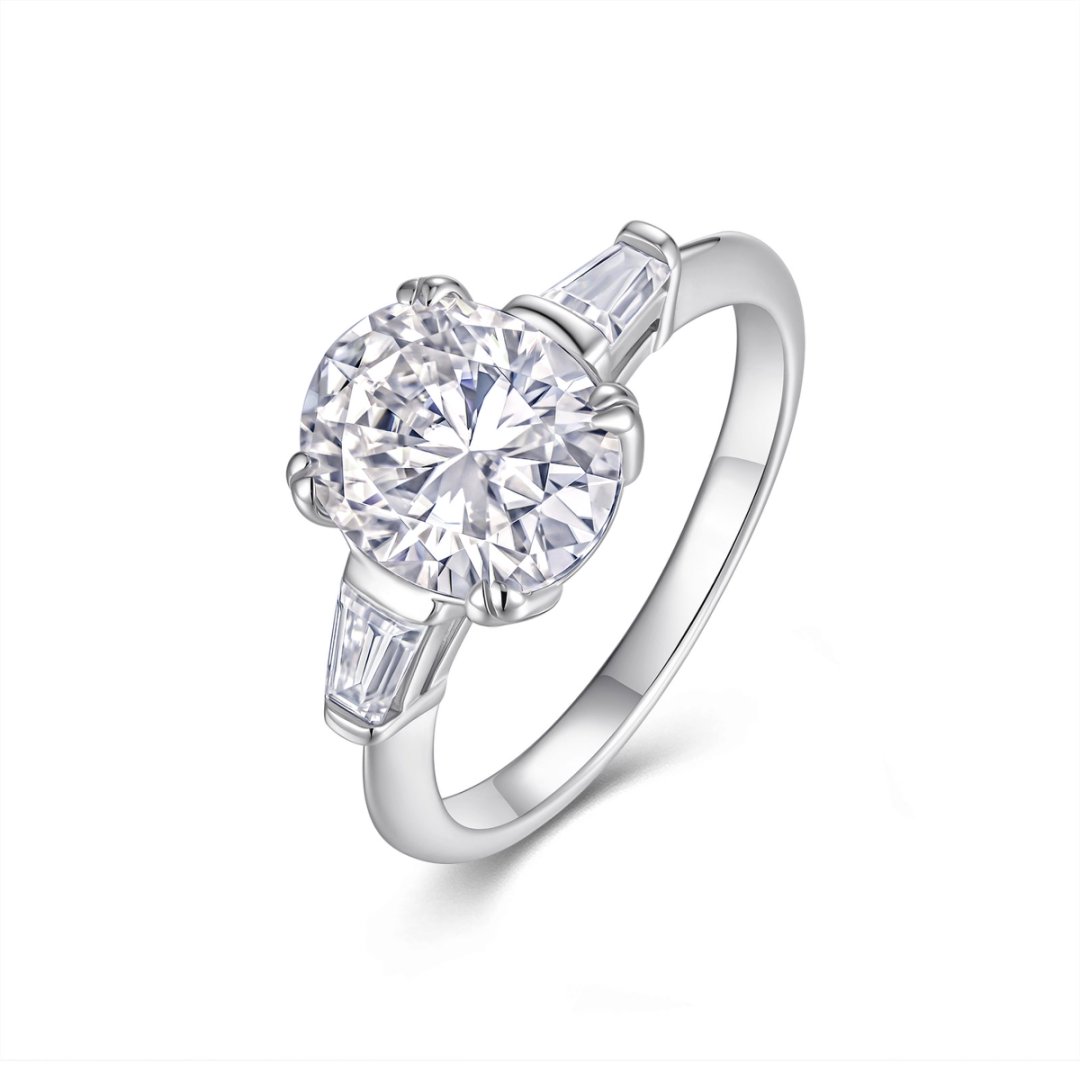
Set the engagement ring on its side so you can see the shank and the structure that holds the stone. Imagine a second ring sitting on the same finger next to it. The part to look at is the space where the wedding band’s top edge would pass. If the basket sits down in that space, a straight band may stop short of the shank. If the basket clears that space, a straight band may tuck underneath, depending on how tall and wide the band is.
Pay attention to the shoulders, the portions of the shank that lead up to the stone. They may widen toward the center or carry small accent stones. A wedding band can clear the basket and still come up against the shoulders. A hidden halo is another feature worth checking from the side. It adds detail below the center stone that may be difficult to see in a face-up photo. The wedding band should leave room around that detail, especially if the halo has exposed stone edges or small prongs.
Terms like “low profile,” “cathedral,” and “solitaire” tell you roughly how a ring is built. Two rings with the same label can have different clearance. Compare the side views in this guide to prong and bezel settings if you’re still deciding on the engagement ring itself. If you already have the ring, use the actual setting as your reference, including any height or shape changes made during customization.
Compare Straight, Curved, Chevron, and Open Bands
| Profile | When to try it | What to check |
|---|---|---|
| Straight | Clear space beside the setting, or you like a deliberate gap | Room around the basket at the band’s full height |
| Curved | Rounded basket or halo interrupts a straight band | Opening width and curve depth |
| Chevron | You want to frame a pear or marquise tip | Clearance near the tip as both rings rotate |
| Open | The center setting needs a wider break in the band | Distance between the ends and any raised stones |
A straight band is easy to wear alone and lets you switch the order of your stack. With a slim band, you may have room to add an anniversary ring later. Try a plain straight band first if you’re shopping in person. It gives you a simple way to see whether the engagement ring allows a straight profile before you start comparing stone shapes, patterns, or pavé.
A shallow curve follows a rounded portion of the setting and often looks softer than a V-shaped band. Ask how wide the curve is at its opening and how far it dips at the center. A curve that looks right in a face-up photo can still meet the basket too early. If the ring has a wide oval or round halo, the width of the contour can matter as much as its depth. With a pear or marquise, a chevron can frame a point. Look for clearance around the tip from both the top and the side, since a chevron can be centered correctly and still sit too high.
An open band leaves a break at the front that can make room for a basket or a broad center setting. Compare the size of the opening and the shape of the ends. An open band with raised accent stones at its ends may need more clearance than a plain one. Try it on its own as well. You may like the open shape by itself, or find that a closed contour sits more predictably for how you wear jewelry. The Paris Jewellers wedding band pairing guide shows how straight, contoured, and open profiles address different setting shapes.
Test How the Rings Sit and Move
Try the rings together on the finger you expect to wear them on. View the stack straight down, from the side, and at an angle. Bend and straighten your finger a few times. The rings can turn slightly during wear, so check what happens when the wedding band shifts off center. If the band slides up into a prong, rubs an exposed stone edge, or pushes the engagement ring sideways, try a different profile or a lower band. If both rings glide against each other at their shoulders, ask a jeweler to identify where they touch and whether that contact is likely to leave visible wear.
Look at the combined width of the stack. Two rings that each fit comfortably alone can feel tighter together. Try a sizing sample close to the combined width if you can. A wide comfort-fit band can also feel different from a slim band with a flat interior, even in the same marked size. Your ring size measurement is a starting point. Use a fitting with rings of similar width to decide whether you need a different size for the wedding band, especially if it will be difficult to resize later.
Give the gap a fair look. A small, symmetrical space can outline a center stone beautifully, and a straight band with that gap might be the pair you enjoy most. Decide if you like it with your hand resting naturally, rather than straightening the rings every time you look at them. If you are considering a slim spacer, measure the whole stack again. A spacer can shift where two rings touch, but it also makes the stack wider and has a fit of its own.
Check Fit Before Buying Online
Send the seller a straight-on photo, a side profile, and a three-quarter photo of your engagement ring. Include its size and, if available, the setting drawing or original listing. Ask whether the quoted band has been paired with your exact model and stone size. A larger center stone or a custom basket on the same model can change where a band touches. A photo of the proposed pair in the same size, shown together at rest, is more informative than two separate product renders.
If you have measurements, provide the widest part of the setting, the band width near the center, and the overall height. A jeweler can help measure the clearance at the point where the new ring would meet the basket. Overall height alone is an imperfect shortcut. A stone may sit high while the basket beneath it still occupies the space the wedding band needs. For a contour or open band, ask the seller to show where they measured the opening and compare the shape of the outline as well as the number.
Before ordering a custom-fit band, check the exchange and resizing terms. Ask how the maker handles a pair that fits the approval drawing but feels tight on your hand. Also ask whether changing the size would alter the contour or leave less room around the setting. If you want a matching finish, compare the metal and plating descriptions for both rings. Photos can make two finishes look similar under studio light even when they appear different next to each other in everyday light.
What to Ask for When Buying Bridal Sets for a Store
For a store buying bridal sets, ask the supplier to identify the exact engagement ring and wedding band SKUs that were fitted together. Tie the fit claim to the center stone dimensions and the wedding band profile. If you stock the same engagement ring in more than one center stone size, document which versions have been checked. A bridal set advertised as flush should have a clear fit example with the exact ring pair the customer will receive.
Give staff side and face-up photos of the approved combination. Record whether a straight band fits, whether it leaves a deliberate gap, and whether a curved band changes how the set feels in the most commonly stocked sizes. A sample in one size is a useful reference for taking inquiries. Before committing to more sizes, ask which dimensions change with ring size and which dimensions remain fixed. That makes it easier to answer a shopper who wants the same look with a different center stone or band width.
For replacement bands and separate orders, keep the fit details with the product record and ask whether a replacement will be made to the original profile. If you are comparing styles for a bridal assortment, start with the Cristiera moissanite ring collection. When asking about a matching band, include the ring style, center stone dimensions, and whether you want the pair to sit flush or leave a visible gap.
Frequently Asked Questions
Does a wedding band have to sit flush with a moissanite engagement ring?
No. A modest gap is a legitimate style choice and can work particularly well if you want a straight band that looks good on its own. Check that both rings sit comfortably and that the wedding band does not press on a stone, prong, or halo when the rings move.
Can I wear a straight band with a low-set moissanite ring?
Sometimes. It depends on the space beneath and alongside the basket, along with the height and width of the wedding band. Try a straight band of comparable dimensions against the actual ring or ask the seller to show the pair from the side.
Which wedding band works with an oval moissanite engagement ring?
Start with a straight band if the setting has enough space. If it hits the basket, try a shallow curved band or a deeper contour shaped around the setting. The way the oval is mounted matters more to fit than the outline of the stone by itself.
What kind of band should I try with a pear-shaped moissanite ring?
A chevron is a useful starting point when you want to echo the stone’s point. Try it in the orientation you plan to wear and check the space around the tip when the rings rotate. A straight or open band may also work, depending on the setting.
Should my engagement ring and wedding band be the same size?
They can be. The total width and the inside shape of each ring influence how tight a stack feels, so try them together before choosing. For a wedding band you will also wear on its own, check that the size feels secure in both situations.
Can I choose a matching wedding band without sending in my engagement ring?
Often you can, if the jeweler has identified the exact model and has already fitted a band to it. For a custom or undocumented setting, provide photos and measurements. Ask if the jeweler can verify the clearance from those details or would need the ring in hand for a reliable fit.