
The setting on a moissanite tennis bracelet determines how metal meets each stone. Prongs hold the stone at discrete points, a bezel surrounds its outline with a rim, and a channel uses opposing walls to retain a row of stones. These structures create different outlines and different points to inspect. The complete bracelet also depends on its joints, clasp, metal, dimensions, and workmanship.
For a useful comparison, hold stone dimensions and finished length as close as possible. Otherwise, a difference attributed to the setting may actually come from larger stones, heavier links, or a different bracelet size. This guide explains what each setting changes and how to evaluate a finished sample without assuming that the name guarantees its quality.
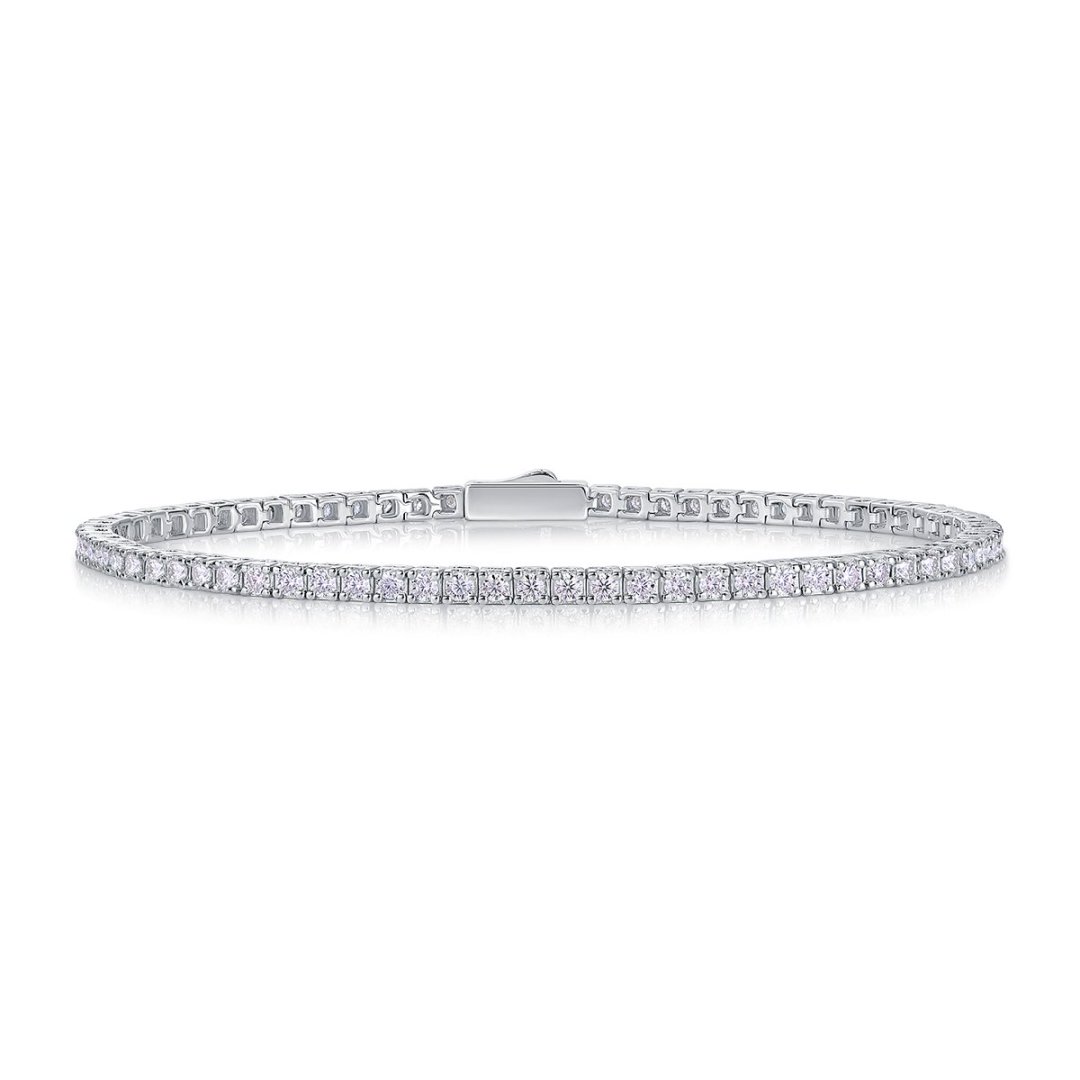
Separate the Setting From the Link Construction
A tennis bracelet is an articulated assembly. Each stone sits in a mount, and the mounts connect to form a flexible line. The setting secures the stone within that mount. The joints allow neighboring parts to move. These functions interact, but they should be assessed separately. A photograph showing a neat row of stones does not reveal how smoothly the bracelet bends around a wrist.
Ask for a side view and an underside view as well as the usual face-up photograph. Look for how high the stones sit, where the connections occur, and how much metal contacts the wrist. An open underside may give access for cleaning. A more enclosed mount may conceal part of the stone and change the profile. Neither arrangement establishes overall quality without examining the finished work.
The terminology also deserves checking. Sellers sometimes use “claw” and “prong” for closely related structures. A decorative square outline around a round stone may be described as a box setting even when prongs retain the stone. Ask which parts actually hold the stone and which parts create the visible shape. That distinction makes comparisons clearer when product names vary between suppliers.
Prong Settings and the Number of Contact Points
| Design | Visual structure | Check before ordering |
|---|---|---|
| Independent prongs | Discrete retaining points around each stone | Tip placement, seating, and joint movement |
| Shared prongs | Some retaining points serve adjacent stones | Exact shared structure and repair access |
| Full bezel | Metal rim around the stone perimeter | Rim finish, consistency, and profile |
| Channel | Stones retained between opposing walls | Alignment, section articulation, and service method |
In a prong setting, individual pieces of metal extend over portions of the stone’s edge. Rounded tips and more pointed claw tips create different visual details. The number and arrangement of prongs influence the outline seen from above. A three-prong mount can produce a more triangular impression, while four-prong mounts often give a more squared rhythm around round stones. The actual appearance depends on the shape of the mount and the spacing between stones.
More prongs do not, by themselves, establish a stronger bracelet. Each prong must be proportioned and seated correctly, and the stone must fit its mount. A poorly finished four-prong sample can present problems that a well-made three-prong sample avoids. Compare the tips under magnification and look for consistent placement rather than relying on the count as a quality score.
Prongs leave portions of the stone’s perimeter visible. That exposed outline is part of their visual appeal, but it creates areas where a raised or damaged tip may catch. During a sample inspection, look for lifted tips and obvious gaps. Avoid testing retention by levering the stone or pulling at the prongs. If a stone appears to move during ordinary handling, set the piece aside for a jeweler’s assessment.
Shared Prongs Need a Clear Construction Explanation
A shared-prong arrangement uses some of the same metal points to retain adjacent stones. It can create a closely connected appearance with less interruption between stones. Ask for an enlarged photograph showing two neighboring stones so you can see what is shared. The phrase sometimes appears in listings whose actual construction differs from the buyer’s expectation.
Because components can serve adjacent stones, repair questions should be discussed in terms of the actual mount. Ask how a loose stone would be tightened and whether replacing a damaged component could affect its neighbor. This does not mean every repair will involve multiple stones. It means the service method depends on the structure, access, and extent of the damage.
For a store comparing samples, keep a diagram or a clear macro photograph with the SKU. Staff can then explain the design accurately and send useful information to a jeweler if a customer needs service. A supplier description that identifies independent mounts, shared retaining points, and articulation is more useful than a general promise of “secure setting.”
Bezel and Partial Bezel Settings
A full bezel retains a stone with a metal rim around its perimeter. From above, that rim becomes part of the bracelet’s design. It can give each stone a clearly defined border and cover more of its edge. A partial bezel covers selected portions of the outline and leaves other sections exposed. Compare the actual coverage in photographs, since partial bezel designs can vary considerably.
A bezel may offer a smoother perimeter around the stone, but inspect the rim and the joints for uneven edges. A poorly finished rim can still feel rough. Check whether the stones sit at consistent heights and whether the rims follow their outlines evenly. For round stones, look for uniformity across the line rather than judging a single attractive center section.
The rim changes the amount of visible metal and the apparent relationship between stone and mount. It does not provide a universal prediction of brightness. Stone cutting, cleanliness, viewing angle, and lighting affect what you see. Compare samples under the same ordinary lighting as well as under spotlights. If you prefer the open appearance of prongs, evaluate that preference alongside how the finished bracelet feels against your wrist and clothing.
Channel Settings and Structured Rows
A channel setting holds stones between opposing metal walls. The result can have a more continuous, structured outline. Stone shape, spacing, and the design of the sections influence the appearance. Angara’s overview of tennis bracelet settings illustrates the basic differences among prong, bezel, and channel construction.
On a flexible bracelet, ask how the channel sections articulate. A bracelet should be assessed as a series of moving components, even if its face-up appearance suggests a continuous strip. Compare whether the sides feel bulky on your wrist and whether the sections move smoothly within their intended range. Do not sharply fold the bracelet to test flexibility.
Check the alignment of the walls and the consistency of the stones within each section. A visibly uneven stone or an irregular space calls for closer inspection. Ask how a replacement stone would be matched and fitted if one were damaged later. The term “channel” alone cannot tell you the labor involved, the availability of replacement components, or the ease of shortening the finished bracelet.
Compare the Finished Profile and Fit
Use the complete bracelet width and height as well as the stone dimensions. A bezel border can add visible width around a stone. Prong mounts can sit at different heights above the wrist. Channel walls can contribute to the overall profile. Ask where the supplier took each measurement and whether the stated width refers to the stones or the complete mount.
Try each sample at an appropriate length. Excess length can make a bracelet roll or catch in ways that confuse a setting comparison. A very close fit may restrict comfortable movement. If you need a starting point, our tennis bracelet length guide explains how to evaluate the fit. Keep the length reasonably consistent before deciding which setting feels better.
Notice where the bracelet rests when your wrist bends and where it meets a sleeve. Check the underside for roughness and look at whether one joint remains stiff. An attractive setting cannot compensate for an uncomfortable connection. The clasp also needs its own check. It should engage as designed and align with the rest of the bracelet, with any safety catch operating independently as intended.
Ask About Metal, Finish, and Repairs
Compare the same metal and finish if you want to isolate the effect of setting style. Metal weight, alloy, component dimensions, and plating can influence price and appearance. A lighter sample may use a different construction rather than a more efficient version of the same design. Request the complete specification before treating a lower weight or price as an advantage.
Ask whether a jeweler can tighten stones, replace individual links, and shorten the bracelet while retaining normal articulation. For plated pieces, ask whether a repair may require refinishing. Availability of matching parts can matter as much as the initial setting choice. Keep any removed links after professional shortening if the jeweler recommends retaining them for future service.
Cleaning access is another practical consideration. Dirt can collect beneath stones and around joints in any of these designs. Follow the maker’s instructions for the metal and finish. GIA’s jewelry care advice recommends considering the complete piece and leaving ultrasonic cleaning to professionals who can assess its suitability. A gemstone’s durability alone does not establish that every component is suitable for a particular cleaning process.
Use a Repeatable Sample Inspection
For procurement, compare two samples with a short written record. Note stone dimensions, finished length, complete width and height, metal, finish, clasp, and setting construction. Photograph the same sections from above, below, and the side. Examine the joint beside the clasp as well as sections in the middle, since different parts of a bracelet may reveal different finishing details.
Record observations rather than unverified rankings. “One joint stays stiff during gentle movement” is actionable. “Feels premium” is harder for a supplier to investigate. Keep the approved sample and ask which construction details will be held consistent in a repeat order. Our shipment inspection guide covers how to turn sample observations into checks at delivery.
Browse the Cristiera bracelet collection for style references when preparing an inquiry. Include the stone dimensions, setting reference, target length, and finish you want to compare. Ask about available construction options for the specific style, since a photo reference does not establish that every setting can be supplied in every configuration.
Frequently Asked Questions
Which setting is best for a moissanite tennis bracelet?
Choose by comparing the finished samples. Prongs emphasize an open stone outline, bezels add a metal border, and channels create a structured row. Fit, joints, clasp, workmanship, and repair options should guide the choice alongside appearance.
Is a four-prong bracelet always more secure than a three-prong bracelet?
The prong count alone cannot establish security. Stone fit, prong dimensions, seating, finishing, and wear all matter. Inspect the actual bracelet and have suspected movement or damaged retaining points checked by a jeweler.
Does a bezel setting make moissanite look less bright?
A bezel changes the visible outline and covers more of the stone’s perimeter. The appearance of brightness also depends on cutting, cleanliness, lighting, and viewing angle. Compare similar stones in finished samples under the same conditions.
Are shared-prong bracelets harder to repair?
The service method depends on which points are shared and what has been damaged. Ask a jeweler or supplier how the specific construction is repaired and whether matching components are available. A general setting name cannot predict every repair.
Can a bezel or channel tennis bracelet still be flexible?
Yes, when the mounts or sections are joined with appropriate articulation. Check the moving joints and try the finished bracelet at a suitable length. Avoid sharply bending or twisting it as a strength test.
What should a wholesale buyer specify besides the setting name?
Specify stone dimensions, metal and finish, finished length, complete profile, clasp, and the construction shown in the approved sample. Keep detailed photographs with the order so any proposed substitution can be reviewed before production or shipment.