
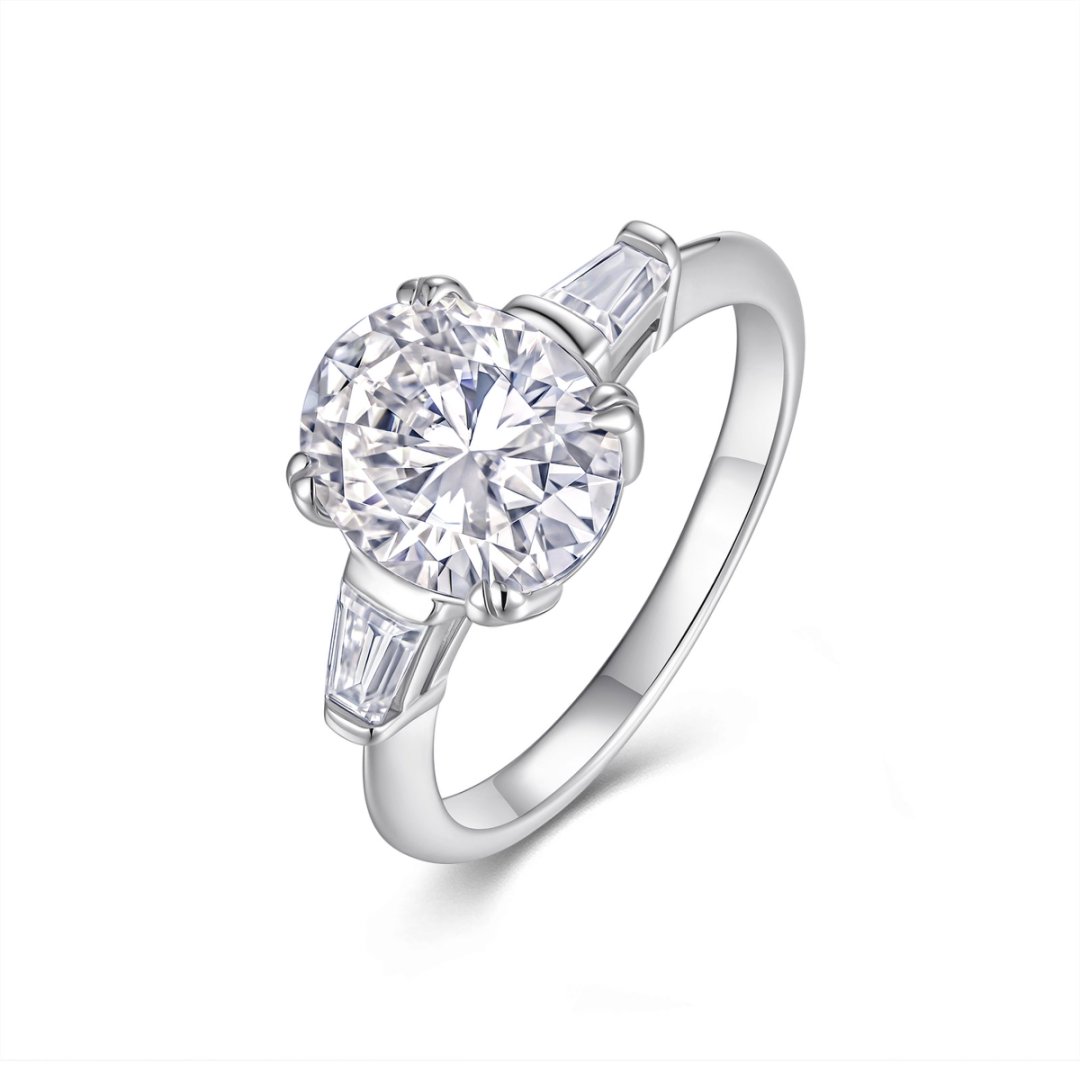
Four prongs leave four relatively open stretches around a round moissanite. Six place more points of metal around the circumference, often giving the outline a more continuous circular rhythm. That is the distinction you can see immediately from above. The more important decision is whether the tips, the structure beneath them and the proportions of the actual ring work together. A fine six-prong head and a substantial four-prong head can look entirely different from what their numbers suggest.
Read the outline before counting the tips
Set a top-view photograph at roughly the size at which you would see the ring on your hand. Four evenly distributed tips can give a round center a suggestion of four corners. The effect is especially apparent when the tips are broad or contrast in color with the stone. Six smaller points can repeat the curve more closely. Move the same pictures back to full-screen size and you may reverse your preference simply because the metal tips now seem much more prominent.
Look at their orientation relative to the band. Four tips arranged diagonally around the stone draw a different outline from four arranged at the top, bottom and sides. A six-prong design can also place a tip at the twelve o’clock position or offset the whole arrangement. Try rotating an isolated drawing on paper while keeping a separate sketch of the band fixed. A subtle change in orientation can determine whether your eye sees a circle, a crosswise frame or a pair of emphasized shoulders.
When viewing two samples, cover the band on each photograph with slips of paper and look only at the head. Then reveal the shoulders. A solitaire with broad tapering shoulders may look balanced with more visible metal at the stone. On a narrow band, the same tip shape might dominate. If one sample has small accent stones and the other is a plain solitaire, you are also comparing two different surroundings. Try to hold the band width and general style steady for your first comparison.
Compare tip shape and visible coverage
A prong is more than the little dot visible from above. The portion that meets and retains the stone has a particular shape and contact area. The visible end may appear rounded or form a more pointed claw. Two rings with the same count and center diameter can therefore show different amounts of metal on the face of the gem. Ask for a straight-on image of the finished setting. A drawing prepared before setting may show excess material the jeweler expects to shape later.
Look for a repeatable pattern in the finished top view. Are corresponding tips similar in size and placement? Is one tip visually much larger, or is the camera looking at the head from a slight angle? In a tilted photograph the nearest two prongs can appear larger simply because they sit closer to the lens. Ask for a level image before deciding that a rendering or finished sample is asymmetrical. A second view can settle an apparent defect without guesswork.
For a small center, the proportion of tip to stone matters particularly strongly. Imagine two round centers shown enlarged to the same screen width although their actual diameters differ. Their prongs may look similarly delicate in the pictures while appearing very different on the hand. Request the real stone diameter and an uncropped hand view of the same size variant. When a seller offers one photograph for multiple center sizes, ask which combination was actually photographed.
What additional prongs can and cannot tell you
More points of retention can provide additional support if one is damaged. Four prongs can expose more of the stone’s perimeter. The Gemological Institute of America’s comparison of four and six prongs discusses these trade-offs for diamond solitaires. The same basic layout questions are useful when looking at a round moissanite. The security of your particular ring still depends on its materials, construction, finished setting and present condition. Count is a design clue, not an inspection result.
Consider a ring whose tips were knocked against a hard object. Seeing five apparently straight tips beside a sixth that looks displaced does not establish that the stone is safe to wear. Nor can a buyer conclude from a clean top photograph that a four-prong head is poorly set. If the stone shifts, a tip appears raised or the head changes shape after a blow, set the ring aside and have it examined. Avoid pressing the stone or bending the metal to test it yourself.
A retailer comparing two suppliers should ask who checks the finished setting, what is examined and how concerns are handled after delivery. Request photographs from the actual sample as well as any production render. The practical question is what condition is accepted and how that decision is recorded. A promise that six prongs are always secure is far less useful than a sample that matches the approved construction and a clear procedure for inspecting any piece that arrives with a suspect tip.
The side view can change the decision
Turn the ring through ninety degrees and look across the finger. Notice how high the stone sits, where the prongs begin to rise and how much space lies between them. Some settings have a rail joining parts of the head. Others present a different arrangement from the side. A larger number of visible uprights can make this view feel more architectural; the same uprights may be almost invisible in a top view. Decide whether you like that side silhouette before concentrating on fine differences in tip shape.
A four-prong ring is not inherently lower than a six-prong ring. Compare two measured heights using the same reference points. A listing that gives basket height alone is difficult to compare with one that gives the full projection from the finger to the top of the stone. Ask the seller to mark the measurement on a side photograph. If the concern is catching the ring while pulling on gloves, a side view of the finished fingertips of the prongs is especially helpful.
If you stack a wedding band beside the ring, bring that band to the appointment. A neighboring band may clear the tips and still meet a support lower down. Try both rings in their normal order and look from both sides. Does contact occur at a smooth intended surface, or at a projecting part of the head? A photograph of the two pieces lying on a tabletop can conceal contact that appears when they follow the curve of a finger. Ask a jeweler to assess repeated rubbing.
A sample comparison that isolates the difference
Ask to see two round centers of similar diameter in comparable metal colors. Place them against the same neutral background under the same light. Look first at reading distance, next at the distance of a conversation and finally from the side. Describe the difference without using the words four or six. For example, “The first stone shows a strong diagonal outline, and the second reads as a circle with a taller basket.” This exercise identifies the actual preference you want the seller to address.
Try one sample on your hand and look away for a moment. When you look back, what do you notice first? Some buyers like seeing a crisp metal frame, particularly on a plain band. Others want to notice only the round stone and are willing to examine several head styles to achieve that effect. If the apparent winner changes as soon as you lower your hand, try it in the light of a doorway or window rather than relying entirely on display lighting.
For an online order, send a focused request. Give the stone diameter, band width and metal finish you are considering, then ask for top, side and worn views of that configuration. If the photos show another size, have the seller identify the difference. For a custom version, agree on tip orientation, intended finished appearance and the approval stage at which you can see the set stone. Keep the accepted image with your order confirmation. It will help if you come back later for a matching piece.
Choosing a ring you can maintain
Ask what the maker recommends for inspection and what service is available near you. This matters for someone who wears one ring most days, travels often or cannot easily return a piece to its original seller. Find out whether another jeweler’s adjustments affect the seller’s service terms. Give any jeweler working on the piece the material and finish information you received with the ring. Keep the original photographs, especially if the prongs have a distinctive hand-finished shape.
Browse moissanite ring designs with a short list: the top outline you like, the amount of metal you want to see, the acceptable side height and the fit beside another band. If two designs satisfy those criteria, decide which you prefer in ordinary light. Choosing between well-executed settings is partly a matter of taste. The number of prongs is a useful way to narrow the search, provided you still look closely at the ring that will arrive.
Frequently asked questions
Will six prongs make the stone look smaller?
It depends on how much metal the tips cover and how clearly they define the outside edge. Six slim tips may draw a neat circle, while four broad tips might cover more of the visible surface. Compare the same stone diameter at actual scale before attributing the effect to count alone.
Does a four-prong setting always sparkle more?
Pictures of unrelated rings cannot establish that. Stone cutting, lighting, camera angle and cleanliness all affect the impression in an image. Compare finished rings under the same conditions and look at the amount and placement of visible metal. Choose the appearance you like without relying on a simple prong-count formula.
Which prong orientation is best for a round center?
Start with a top view that includes the band. Decide whether you like a tip aligned with the finger or prefer open space at that point. Mark the intended orientation on a custom order. A verbal request for a classic setting can mean different arrangements to the designer and the buyer.
Can a four-prong ring be converted to six?
Ask a jeweler to examine how the head connects to the shank, the dimensions of the stone and the proposed replacement. It may involve a new head or more extensive work. Request an estimate and a side view of the intended result before committing, particularly if the ring must still fit an existing band.
What if one prong snags on a sleeve?
Remove the ring gently once the fabric is free and avoid pulling more fibers across the tip as a test. Note which tip caught and whether its position looks different from the others. Repeated snagging or a visibly changed tip is a reason to have the setting inspected before wearing it again.
Which detail should a wholesale buyer approve last?
Review the actual finished sample after setting. Check the agreed top outline and orientation, the consistency of corresponding tips and the finished side profile. Keep the sample reference tied to its stone diameter and ring size. A drawing approval records intent; the finished sample shows how the workshop executed it.