
If you want to know how big a moissanite will look on your hand, start with its measurements in millimeters. Look for the diameter of a round stone, or the length and width of an oval, pear or rectangular stone. Then check what the carat figure describes. A ring advertised as “two carats” might have a single center stone described in diamond equivalent weight, or several stones whose weights have been added together. Those two rings can look quite different across a table.
Imagine choosing between a round solitaire and an oval ring for someone who tried on a friend’s ring and liked its size. You have a photograph but no measurements. Before trying to match the price or carat number, ask what they liked about it. Was it the space the stone took up across the finger, the length it covered toward the knuckle, or the little rim of metal framing it? Each answer leads to a different measurement.
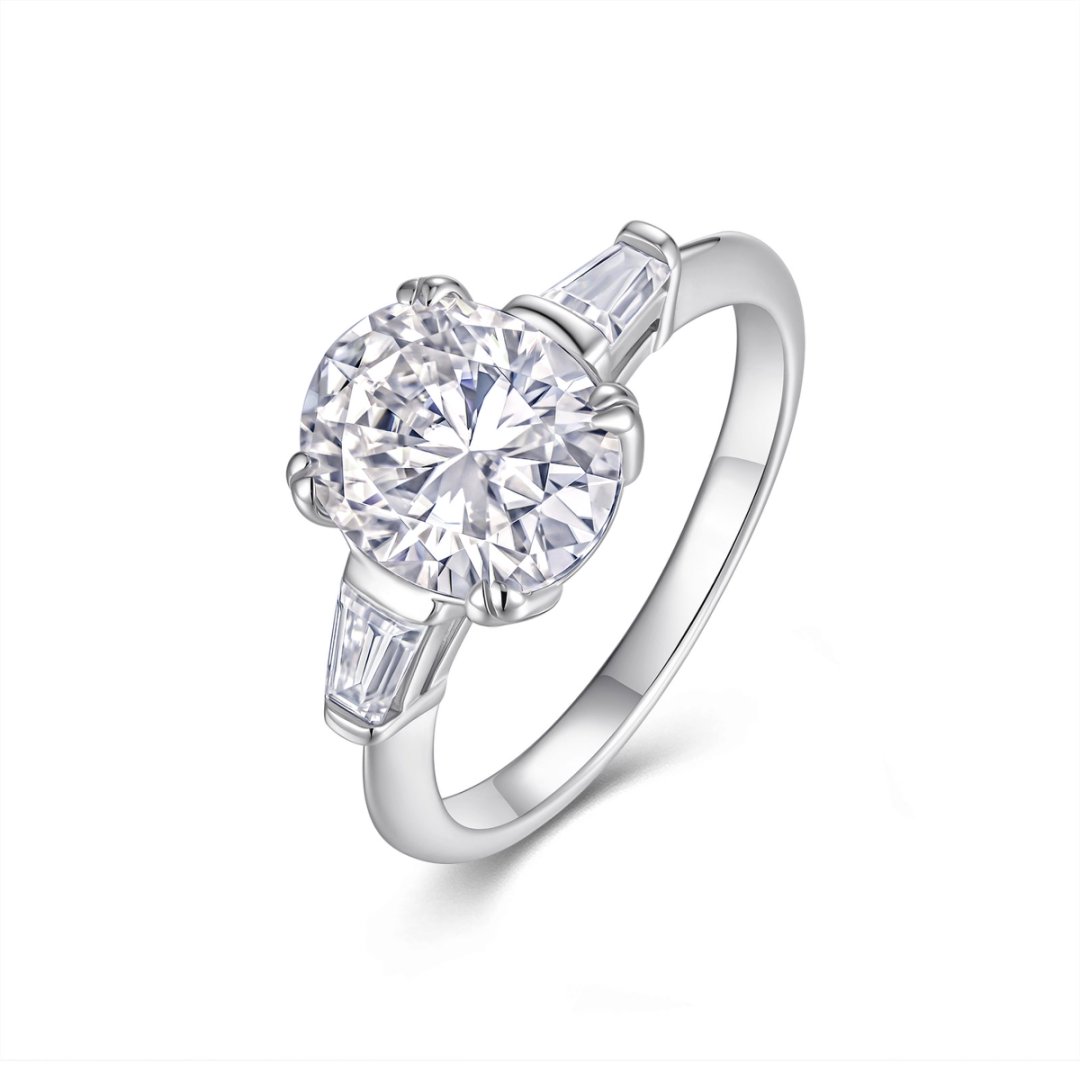
What the numbers on a ring listing actually describe
A carat measures weight. A millimeter measures distance. Diamond equivalent weight, often shortened to DEW, is a comparison used by sellers to describe a moissanite in terms of the approximate weight of a similarly sized diamond. In its introduction to moissanite, Charles & Colvard explains that its stones are described using millimeters and/or diamond equivalent weight. The comparison is useful when you know the diamond size you liked and want a starting point for shopping.
For an individual ring, go one question further. Is the number beside the price the weight of the actual moissanite, a diamond equivalent, or a total for the whole ring? A clear listing might say “round center, 6.5 mm diameter” and give an approximate equivalent figure separately. Another might give the center dimensions and describe the accents only by total weight. Both descriptions can be perfectly useful, provided you know which figure belongs to which part of the ring.
When a seller answers with a number alone, ask for the unit and the component in the same sentence. “What is the diameter of the center moissanite in millimeters for the variant I selected?” usually gets a clearer answer than “How large is this ring?” Save the reply with the selected style and size. A single product page may use the same photograph for several center options.
Compare round and elongated stones on paper
For a round stone, begin with a circle. Draw a 6 mm circle and an 8 mm circle on plain paper, using a ruler to check the widest distance. Cut them out or shade them in and rest them on the finger where the ring will sit. A change of two millimeters sounds slight until you see both outlines against the same hand. A round outline 8 mm across has about 78 percent more area than one 6 mm across, because circle area increases with the square of the diameter. That calculation describes the outline only. It says nothing about sparkle.
An oval needs two measurements. An 8 × 6 mm outline and a 9 × 5 mm outline have noticeably different silhouettes even though both could be described as elongated. The first has a length-to-width ratio of about 1.33 and the second about 1.80. To find the ratio yourself, divide the longer dimension by the shorter one. Ratios are especially handy when you liked the shape of a stone in a photo and want to keep that outline while going up or down in overall size.
Draw both ovals with their long axes pointing toward the fingertip. Now turn one sideways. The dimensions stayed the same, yet the amount of finger width covered changed. This is why an east-west setting deserves its own try-on even if you know the measurements from a traditional north-south ring. With pears, draw the point as well as the curved end. With cushions, round the corners. A rectangle drawn around either stone makes the corners look fuller than they will be in the finished piece.
| Stone outline | Measurements to request | What to draw |
|---|---|---|
| Round solitaire | Center diameter | One circle at the stated width |
| Oval solitaire | Center length × width | An oval oriented as it sits on the finger |
| Halo ring | Center and complete head dimensions | Two concentric outlines matching the design |
Separate the center stone from the finished ring head
Picture a 6.5 mm round solitaire beside a halo ring with a smaller center. From a few feet away the halo might look wider. That impression is real, but it answers a different question. The outside measurement of the head includes the surrounding stones or metal. If the look you love is a broad, bright circle, ask for that outside width. If you love the uninterrupted face of a solitaire, ask for the center diameter on its own. You can use both measurements to compare the moissanite rings in a collection without equating two very different designs.
The shank, or band, gives your eye another point of reference. Lay the same paper circle over a narrow strip of paper and then a wider strip. On the narrow strip the center commands more attention. On the wider one the two parts may read as a single shape. If you plan to wear two rings together, place a second strip alongside the first and repeat the comparison. This quick exercise often explains why a stone you liked in a solo photograph feels different in a bridal stack.
A top view can’t tell you how far the ring stands above the finger. Ask for a side photograph of the actual setting and, when height matters, a measurement from the inside top of the band to the top of the stone. Confirm how the seller took it. Two listings may use different reference points. For anyone intending to add a straight band later, our wedding band pairing guide explains how the space below the center affects the fit.
Get a fair comparison from photographs and videos
Try this when you have two listings open on your phone. Set the images to the same apparent band width and look again. If you don’t know the actual band widths, the comparison is already on shaky ground. Product photographers crop each picture to show detail, so a smaller ring can occupy more of the screen. The easiest request for a retailer to fulfill is often a single photo of the two options beside one another, taken from the same distance and angle.
For an on-hand photograph, ask which center option the model wears and whether the image shows the exact setting. A ring-size number helps put the shot in context, although two people who wear the same size can have different finger shapes. A video that starts face up and tilts slowly to the side adds information about the profile. If you mostly wear jewelry indoors, request a view in ordinary diffuse light. A spotlight can tell you that the stone flashes under a spotlight. It gives you much less information about how clearly you will see its outline at your desk.
For a surprise gift, borrow a ring the recipient already wears on the intended finger if doing so is practical. Place it flat beside a millimeter ruler and take a photograph from directly above. Measure a familiar decorative element, even if it is a plain metal disc. Knowing that they happily wear a 7 mm disc is a more personal reference than a stranger’s idea of a subtle size. Keep finger fit as a separate question. A large center can sit on a small band, and the center diameter cannot tell you which ring size to order.
Work through a two-ring shortlist
Suppose one listing offers an 8 × 6 mm oval solitaire and another offers a 7 × 5 mm oval surrounded by accents. You like the second product photo more, but what you really want is a clear oval shape that reads from arm’s length. Ask for the outer measurements of the halo and a side-by-side picture. Sketch the larger center on one piece of paper. For the other ring draw the smaller center and then the full outline of the halo around it, using the seller’s figures. Leave the boundary between them visible.
Now look at the two drawings from the distance at which you normally see your own hand. If the smaller oval disappears into its surround, a larger outer measurement will not give you the distinct center you wanted. If the halo gives the small center a frame you love, you may prefer it even when the solitaire has the larger individual stone. Write the reason down before comparing prices. It keeps the choice tied to something you can see when a promotional label introduces a bigger carat number.
Before checkout, match the chosen option to your notes and save the product description or seller’s confirmation. Useful details include shape, center dimensions, whether any quoted weight is actual or equivalent, finished head dimensions if supplied, band width, and which image represents your selection. If the choice depends on how the ring feels in person, read the return terms for that exact configuration before adding engraving or commissioning a size change.
Frequently asked questions
What does a 1 ct DEW moissanite actually weigh?
DEW alone cannot tell you the exact weight of an individual moissanite. It expresses an approximate diamond comparison. Ask for the actual stone weight if you need it for a specification or inventory record. For a visual comparison on your hand, the diameter or the length and width will usually answer the question more directly.
Can I use an online ring image at actual size?
Only after checking its scale on your own screen or printout. If the guide includes a scale bar, measure that bar with a physical ruler. Zoom level, print scaling and display settings can all change the result. If no reference is supplied, draw the stated millimeter dimensions on paper instead.
Does total carat weight include the halo?
A total can include the center and surrounding stones. Read the seller’s definition to see which stones are counted and whether the figure uses actual or equivalent weights. If your priority is a prominent center, ask for its separate dimensions even when the listing gives a detailed total.
Will an oval always look bigger than a round stone?
An oval can cover more distance along the finger while a round covers more across it. Decide which direction matters to you, then compare the relevant dimensions. Broad shoulders, a pointed end, a surrounding bezel and the way the stone is oriented can all change your impression of the finished ring.
Can a jeweler replace my stone with another of the same width?
Width is only one part of fitting a replacement. The jeweler also needs to consider shape, depth, the outline at the setting and the condition of the mounting. Have the ring assessed before buying a loose replacement, especially if the new stone comes from a different cutter or has a different profile.
Which number should I request first if the listing gives no measurements?
For a solitaire, request the face-up center measurements for your chosen variant. For a halo or cluster, request those measurements and the outside dimensions of the complete head. That gives you enough information to draw a useful outline and decide whether a side view or an in-person try-on is your next step.