
A tennis bracelet fits easily into a pocket. That does not make a pocket a good place for it. Pick up a typical line bracelet by one end and its settings follow each other in a flexible row. Put it loose beside a charger and a set of keys, and those same little settings can turn against one another while the clasp carries pressure from the rest of the bag.
A useful travel case gives the bracelet room to follow its natural curve and keeps other objects away from it. You can test whether the case does both before you leave home. Start on a table with good light, a clean soft surface and the bracelet you plan to take.
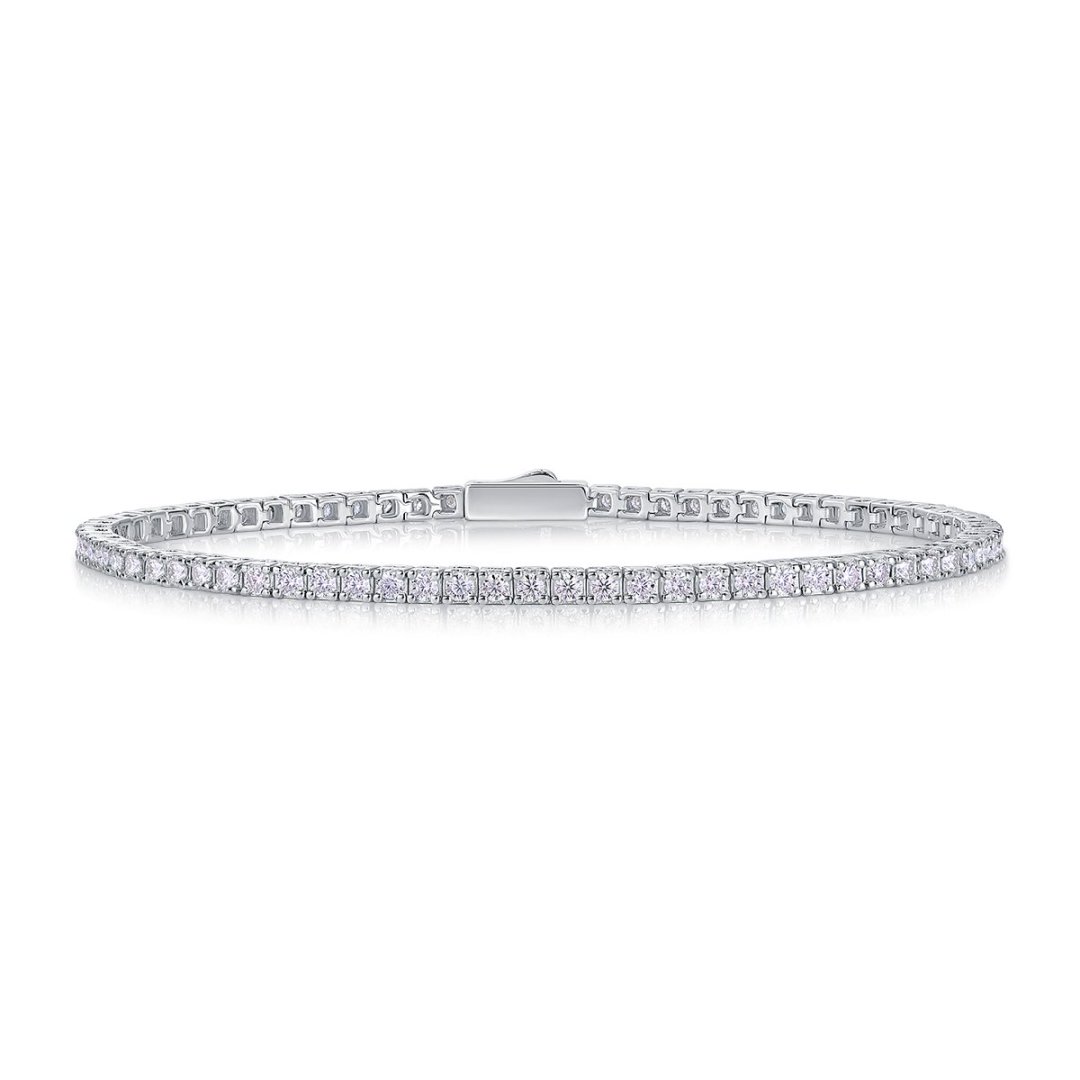
Learn the curve before packing
Lay the bracelet face up on the soft surface and ease it into a broad curve with both hands. Watch the spaces between the links. In the direction the bracelet naturally wraps around your wrist, the row should take up its familiar shape without your having to pinch any joint. Stop where you feel resistance. The goal is to see the shape your container must accommodate. There is no need to test how far a joint will bend.
Look at the clasp as part of that outline. Box clasps, hinged safety arms and other fasteners often occupy a longer or stiffer section than the individual stone settings. A small round container may fit most of the bracelet beautifully while forcing the clasp against its wall. Give that section a reasonably straight place to rest. If you are choosing among moissanite bracelets for a trip, try this with each actual piece. Similar overall lengths do not guarantee identical flexibility.
This is also a good moment to learn what normal looks like. Take a face-up photograph and one close view of the closed clasp under ordinary light. Include the safety catches if there are any. If you later notice an uneven gap between links, you will have something better than your memory to compare it with. Already seeing a gap, bent catch or raised setting? Leave that piece aside for a jeweler to assess before travel.
Choose a case by its usable interior
A hard or semi-rigid case provides a boundary against surrounding luggage, provided the lid closes without pressing on the stones. Open it and examine the space left after cushions, elastic straps and decorative fittings are taken into account. The outside measurements on a listing tell you little about the distance available between two fitted compartments. Lay a strip of paper cut to the bracelet’s length into the compartment for a first check, then try the actual piece gently.
An oval cushion can work if it is small enough for the bracelet to wrap without tension and large enough to hold the row in a relaxed shape. A cushion designed to fill out a watch strap may be too firm or too large. If you have to pull the bracelet tight just to fasten it, choose another insert. A flat lined compartment can work just as well. Arrange the line in a broad U or loose oval and leave space between the sides so they do not rub.
A soft pouch solves a different problem. It separates jewelry surfaces but offers little resistance to pressure from a full bag. If a pouch is your only liner, place it within a rigid compartment with enough room for the bracelet’s natural curve. Keep the pouch’s drawstring and knots away from the settings. A tightly cinched little bundle sacrifices the space you were trying to preserve.
Pack the clasp so it carries no load
Fasten the bracelet only if the closed position is comfortable around the support. Use the normal sequence for your clasp and engage any safety arm gently. A fastening that clicks properly at home should not require extra force because it is being packed. If the support makes the closure difficult to reach, take the bracelet off and choose a different arrangement. Hands pushing on a catch inside a cramped box can apply pressure in an awkward direction.
With a flat case you may prefer to lay the bracelet open. Keep the two ends apart and seat each in a separate area of the lining so the exposed tongue cannot catch a link or press into another stone. Avoid placing an elastic strap directly over the clasp or over a raised prong. If the lining has retaining tabs, check where they touch the bracelet. They should control movement without forcing a sharp change of direction.
Lower the lid slowly the first time. Does it close as freely as it did when the case was empty? Do you hear metal parts moving against one another when you gently tilt the closed case over the table? Reopen and look. A bracelet piled at one end needs better restraint. One bearing a sharp fold or a clear imprint from the lid needs more room. You can learn both things with a gentle tilt. There is no reason to shake the case.
Give it a place in transit
Put the case where you can retrieve it without emptying a bag onto a counter. A small zipped interior compartment in a bag you keep with you is practical. Keep heavy items from leaning on the case and separate it from toiletries that might leak. On a journey with several transfers, use the same compartment each time. Searching three bags repeatedly creates more opportunities to drop a bracelet than the modest inconvenience of reserving one pocket.
Packing several pieces changes the setup. A chain can slide through an open bracelet link or around a safety arm even if both pieces started neatly side by side. Use a physical divider or independent compartments. Stud earrings and loose backs need a closed space of their own. Look at the case from the side with the lid shut. Some nominally separate sections share enough empty space above their partitions for a small piece to migrate when the case is turned upright.
If you plan to wear the bracelet for most of the journey, bring the empty case anyway. There are ordinary moments when you may wish to take a piece off. A secure case already in your bag gives you somewhere to put it. Avoid wrapping it in a tissue as a temporary solution. A folded tissue looks exactly like something to throw away, particularly in an unfamiliar room.
Unpack over a table and inspect the whole row
Open the case on a clear surface away from a sink or the edge of a bed. Lift the bracelet with two hands supporting its length. If it has shifted, look at where one link meets the next before pulling it straight. A line bracelet can turn over itself in transit. Support the row and allow it to settle in the direction it moves freely. Resistance is a reason to pause. Pulling on both ends gives you little control over which joint takes the strain.
Check the face-up row against the photo you took at home. Look for a setting sitting at a new angle, a gap that stays open or a section that no longer follows the curve of its neighbors. Examine the fastener too. An arm that suddenly swings loose, a tongue that no longer seats or a clasp that opens with ordinary movement deserves professional attention. Put the piece back in its case until it has been checked. A second safety catch does not repair the first one.
If everything looks familiar, fasten the bracelet over the table. Move your wrist normally while your other hand is still underneath. This is a simple way to check that you actually engaged the clasp after unpacking. If a stone catches on a sleeve repeatedly in one place, take note of the position and remove the bracelet carefully. Avoid testing the suspect setting by pushing on the stone.
Adjust the packing plan for the return trip
A case that worked on the outbound journey may need another look once you have bought a souvenir necklace or filled the bag more tightly. Recreate the original space around the bracelet before adding the other pieces. If the case now sits beneath a laptop or a packed shoe, move it. A rigid case helps resist accidental contact, but its hinge and lid still need enough clearance to do their job.
If the bracelet was worn at an event, follow the maker’s instructions for the entire piece, including its finish and any accent materials. For routine packing, make sure the bracelet and lining are dry before closing the case. A case left open on a damp bathroom counter can pick up moisture even when the jewelry itself looks dry. Avoid adding an improvised cleaner or polishing compound immediately before storage, especially if the silver has a plated finish.
On returning home, inspect the insert as well as the bracelet. A torn tab, displaced cushion or dark contact mark can show where the arrangement failed during travel. Replace a worn lining before the next trip. Once you find a setup that keeps the bracelet dry, separated and in its natural curve, photograph the open case with the bracelet in place. That picture makes repacking a five-second decision instead of another experiment.
Frequently asked questions
Can I use a small ring box?
Only if its actual interior accommodates the bracelet without folding or crowding it. A slot intended to hold a ring upright can pinch a link. Try a flat or oval-lined bracelet compartment when the ring insert uses most of the box.
Should the stones face inward or outward?
Follow the natural direction of the bracelet and the way the insert supports it. Around a suitable cushion the stones generally face outward as they would on your wrist. Ensure the lid clears them when closed.
Is it safe to roll the bracelet in a cloth?
A clean soft cloth can separate surfaces, but a tight roll can concentrate pressure on the links. If you use cloth, arrange the bracelet in a broad curve inside a supportive case and avoid knots or thick seams against the settings.
Can two tennis bracelets share a case?
They can share an outer case if each has its own secure compartment. Check that the partition meets the lid closely enough to keep the rows apart when the case travels upright or upside down.
What if a link feels stiff when I unpack?
Set the bracelet on a soft surface and support both sides of the joint. If it does not settle freely or looks different from the surrounding row, leave it in the case and have a jeweler examine it before wearing it.
What is the quickest final check before leaving a hotel?
Open the case on a clear table, visually identify the bracelet and make sure the clasp sits clear of the lid. Close the case, put it in its usual zipped compartment and check the surface where you last took off your jewelry.