
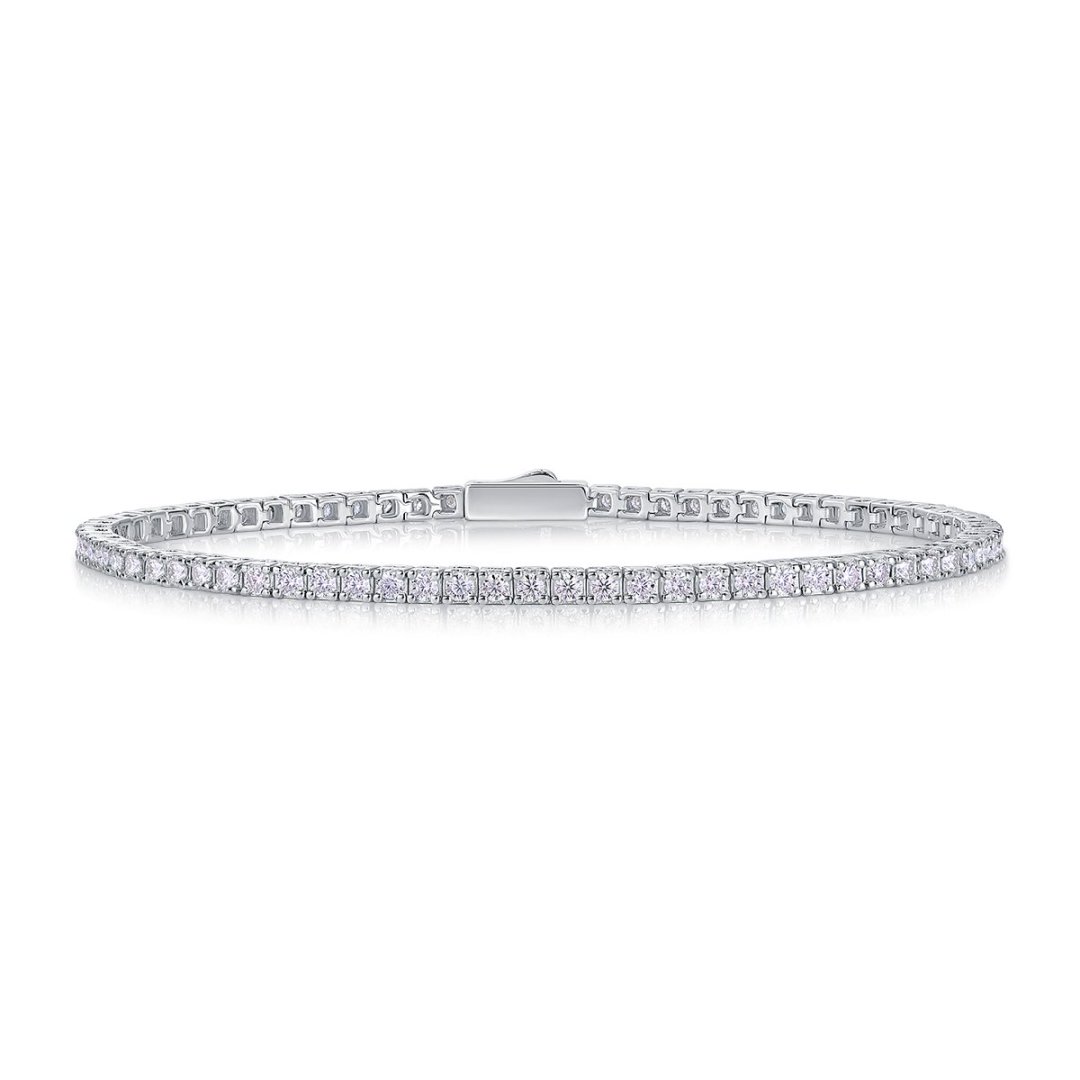
On a uniform tennis bracelet the row keeps roughly the same visual width around the wrist. On a graduated bracelet the stones change size along the row, often building toward a wider central area before narrowing toward the clasp. That description sounds straightforward until a supplier labels two quite different pieces “3 mm graduated.” Three millimeters might be the widest stone, the smallest stone or a shorthand for part of the pattern. To understand the bracelet, ask which stones change size, where the transition occurs and what measurement the quoted number represents.
Follow the row from clasp to clasp
Open the bracelet and lay it in a relaxed curve, with the clasp ends visible. Trace the row from one end to the other with your eye. A uniform round-stone design should show a fairly consistent cadence: a stone, its surrounding metal, the joint and the next stone. On a graduated design, find the point where that cadence changes. A single enlarged center flanked by small stones creates a focal point. A sequence of several size groups creates a broader swell. Both can be described as graduated.
The number of size groups matters as much as the largest and smallest stone. A two-stage transition can have a pronounced shoulder where the row widens. Several smaller increments can produce a gentler transition. Whether either looks more considered depends on the design. A sharply defined center section can be exactly what a buyer wants. If the seller describes a subtle taper and you want one, look at the joins between groups rather than comparing only a photograph of the center with one of the clasp.
Turn the piece gently onto its side or ask for a side-view photograph. Observe whether the larger settings rise higher and whether the base line follows a consistent curve. Some designs widen across the wrist while preserving a relatively even visual line underneath. Others create a pronounced rise toward the middle. Front-facing photographs communicate surface pattern beautifully. They reveal little about whether the center will fit beneath the shirt cuff you usually wear.
Separate stone diameter from finished bracelet width
Stone diameter and outside setting width answer different questions. The first describes the gem, usually in millimeters for a round shape. The second includes visible metal around it. On a non-round design you may need length and width for each stone group. If you are comparing one bracelet with a narrow rim and another with a broader metal frame, matching the largest stone diameter does not guarantee an equal face-up width. Ask for both measurements taken at the same point in the pattern.
For a graduated style, request the narrowest and widest finished widths and the approximate length of the widest portion. A single large center setting can reach the same maximum width as a row with five large stones. Viewed from above the wrist, those two bracelets will not make the same impression. The first offers a distinct accent. The second can read almost like an even-width bracelet from above, with most of the taper visible only at the sides or underneath.
| Dimension | Uniform row | Graduated row |
|---|---|---|
| Stone size | Nominal size and any exceptions | Size for each group and order along the row |
| Outside width | Typical setting width and clasp width | Narrowest, widest and width at the transitions |
| Wrist view | Spacing between neighboring settings | Length and placement of the wider section |
Read a stone map without a technical drawing
A stone map can be a written sequence. For an illustrative design, imagine five small stones, three medium ones, three larger ones, three medium ones and five small ones. That gives nineteen stones across five groups, including three at the center. An actual bracelet may use many more stones. The point of writing the sequence is to identify the center, understand the transitions and make it possible for two people to describe the same pattern without relying on the word gradual.
Mark one end of the map as the clasp tongue and the other as the receiving end. Then compare the map with a full-length image of the ordered size. If the style is intended to be symmetrical, count outward from the center in each direction. If it looks different near the clasp, ask whether a design element or the need to fit a closure accounts for the difference. This may be intentional and entirely acceptable. It is still worth understanding before a retailer promises a mirrored pattern.
Suppose the stock sample is seven inches and you are ordering a longer bracelet. Ask how the extra length is introduced. The maker might add small links near both ends, extend a central group, alter the pattern elsewhere or use a different combination of components. Extending the wide center and extending the narrow ends change the appearance in different ways. Keep the map linked to the finished length shown. Never assume that a cropped photo of one size describes every length on the order sheet.
What the center does on the wrist
Fasten the bracelet normally and allow it to settle. With a uniform design, a small turn usually presents another similar portion of the row. With a graduated piece, the same movement can take the visual center toward one side. Some wearers like the shifting emphasis. Others want the widest part to sit across the top of the wrist. Watch it as you reach for an object and lower your arm. The most useful position to assess is the one it returns to after you stop adjusting it.
Ask for worn views with the clasp visible on the underside. A carefully centered display can make a wide section look longer than it appears once the bracelet curves around a small wrist. Conversely, if a single photo shows only the narrow side, you may underestimate the effect of the large center. Compare a straight-on wrist image with one taken from the thumb side. Those two views show how early the taper becomes visible, which affects the impression more than a solitary maximum width figure.
Try comparing a rolled paper strip at the finished widths you are considering. Draw the proposed taper and mark the central section before wrapping the strip loosely to its intended circumference. The paper gives you a rough idea of which parts of the pattern you can see from above. It cannot imitate the weight, flexibility or exact drape of linked settings. Use it to select two promising layouts, then request a video or a physical sample for the choice that depends on movement.
Compare two quotes with the design held still
A useful comparison begins with the same finished length, metal, finish and general setting type. Next list the stone groups, finished widths and clasp design. If one supplier quotes by total stone weight and another quotes by individual dimensions, ask each to supply the missing description before judging the prices. A high total can come from a longer row of smaller stones or from a more prominent center. Only the pattern tells you what your customer will see on the wrist.
Check whether the photograph belongs to the quoted variant or to an adjacent product with a similar name. Ask for a dated sample reference with the ordered length laid out alongside a ruler and the center section visible. If a quote calls for a continuous graduation but the reference has clearly defined size steps, settle which the supplier is agreeing to make. Keep the accepted photo and map together when you place a repeat order. That saves a great deal of guesswork when another buyer later takes over the account.
For a personal purchase, simplify the same exercise. Write down the widest finished width, the width you see over most of the wrist, and whether you like the view when the bracelet rotates a little. Then put the two prices beside those descriptions. The uniform piece may be the more striking one if its whole row stays broad. The graduated piece may appeal precisely because the visual weight is limited to a short central stretch. Browse bracelet designs with those differences in mind.
Frequently asked questions
Is a graduated tennis bracelet always wider than a uniform one?
No. A graduated pattern tells you that size changes along the row. A fine graduated bracelet can be narrower even at its widest point than a bold uniform design. Compare finished widths in millimeters. If you already own a bracelet with a width you like, use that as the physical reference for both options.
Does graduated mean every stone is a different size?
Many designs use groups of stones at several sizes. Others emphasize a single center with relatively little difference elsewhere. Ask for the order and count of each size group. That information tells you whether the taper will look smooth, stepped or concentrated in the middle when the bracelet is worn.
Does the clasp count as part of the graduation?
Clarify what the seller is measuring. A clasp may be wider, narrower or differently shaped than the last stone setting. For an overall fit comparison ask for the clasp width and height separately. For an appearance comparison look at the transition between the last decorated link and the closed clasp.
Can a graduated bracelet be shortened later?
A jeweler must assess the construction, clasp and pattern on the actual piece. Removing links from one location may shift the center or change the symmetry, even when a length adjustment is technically possible. Before ordering, ask whether the preferred length is available with the intended stone sequence already in place.
Which makes the better gift when I do not know the recipient’s style?
Look at what they wear repeatedly. Someone who likes an even, unbroken line of metal or stones might appreciate a uniform design. Someone who favors a single visual center may prefer a taper. If neither preference is obvious, compare the two worn at normal distance and confirm the seller’s size exchange terms.
Which image should a retailer put beside its size selector?
Show the complete bracelet in a labeled reference length and a wrist photo that reveals the taper. If the count or arrangement varies by length, explain that near the selector and provide a picture or map for each materially different layout. Customers can then distinguish a deliberate pattern change from a photographic difference.