
An east-west oval runs across your collarbones. A vertical oval points down the center of your chest. If you have found two necklaces you like, the quickest way to choose between them is to compare the outside dimensions of the settings at the height where you actually wear a necklace. An oval that makes a beautiful little dash above a crew neck can disappear behind the folded edge of an open shirt. Turn the same outline upright and a surprising amount of it comes back into view.
Start with the outfit you reach for on an ordinary morning. Put on a chain you own, stand at conversation distance from a mirror, and mark where you would like the oval to sit. There is no ideal orientation for a particular face shape. The useful question is which line you want to see between your collarbones and the fabric below.
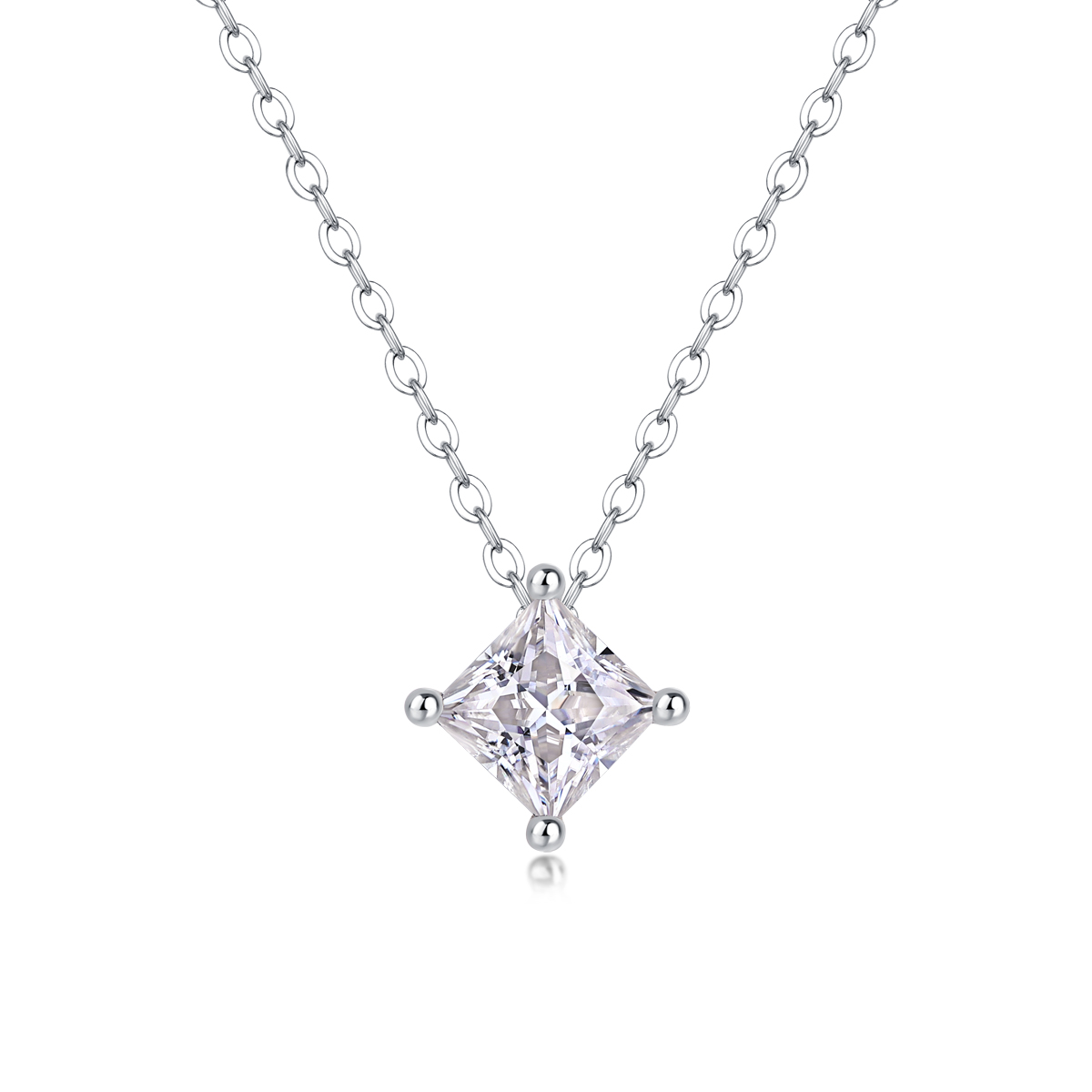
What changes when an oval turns sideways?
Imagine a loose oval measuring eight millimeters by six. In a simple vertical setting the stone occupies about six millimeters of width and eight of height. Rotate it a quarter turn and those dimensions trade places. Its surface area stays the same. What changes is the direction in which your eye follows the outline. The horizontal version often looks like a continuation of the chain. The upright version can look like a small drop suspended from it, particularly when there is a visible loop above the stone.
The metal can complicate that simple comparison. A wide rim, a halo or protruding end caps can add width. A bail, the part through which the chain passes, can add height without adding any stone. In a listing, look for two measurements: the dimensions of the stone and the outside dimensions of the complete pendant including the bail. If only the first pair appears, ask for the second before drawing the outline to scale. Even a careful sketch gives the wrong impression if a third of the finished drop is missing.
| Compare | East-west | Vertical |
|---|---|---|
| Long axis | Across the neckline | Down the neckline |
| 8 × 6 mm stone alone | 8 mm wide, 6 mm tall | 6 mm wide, 8 mm tall |
| Finished footprint | Include side settings | Include bail and rim |
A two-minute paper fitting
Cut two small ovals from plain paper using the quoted stone dimensions. If you have the complete measurements, draw the outer setting around each and trim to that outline. Set one horizontally and one vertically on a dark sheet first. It is easier to notice that you cut one larger than the other here than after you try them on. Use a tiny piece of removable tape on your shirt or pin the paper to a display card held against your chest. Keep adhesive off your jewelry.
Wear the same chain for both views, in the same position. Look straight ahead, then step back from the mirror until you can see the shoulders of your shirt. A phone held close can make a tiny pendant fill the screen. At a natural distance, does the oval read as a distinct shape or mostly as a spot of light? Either effect can be right. If you cannot distinguish the orientations, the more meaningful difference between the two real necklaces may be the rim, chain or overall size.
Try a second pair of outlines with the same width but different proportions. A nearly round oval changes very little when turned. An elongated oval draws a much clearer line across or down the neckline. Two websites may both call a stone oval while showing quite different silhouettes. Keep your paper pieces with the listings until you make the purchase. They give you a reference when a tightly cropped product photograph makes both options appear equally substantial.
What three familiar necklines reveal
With a crew neck, begin by deciding whether the necklace will sit above the fabric or on it. A short horizontal oval can echo the curve of a collar when there is some visible space between the two. If the bottom of the setting rests exactly on the collar seam, the pendant can appear and disappear as the shirt moves. Try changing the chain position before abandoning the shape. A slightly higher placement may give an otherwise quiet pendant a clean outline again.
With an open shirt, button it as you normally would, then sit down. The opening often changes once your shoulders relax. A vertical oval can follow that opening while leaving space at either side. A horizontal oval can be equally attractive if both ends stay visible. If one end repeatedly slips behind a lapel, note whether the chain is off center, the shirt opening is narrow, or the entire pendant is too low. Each observation points toward a different adjustment.
With a V-neck, look at the angle of the V. A vertical pendant can repeat it; a horizontal one can draw a short crosswise line inside it. Choose whichever relationship you like better. A shallow, wide V may leave little room for a long bail and an upright stone, while a deep V may give that same pendant space to stand out. Bring the actual top to a fitting if the necklace is for a particular event. A neckline that sounds similar on paper can sit quite differently.
Follow the chain to its attachment points
Take an east-west necklace off its display card and look at how the chain meets the setting. Two attachment points near opposite ends can make the stone read as part of the chain itself. A horizontal pendant suspended from a single bail has a different outline, with the chain rising above the setting. An east-west description tells you which way the stone points. You still need the side and back views to understand how that particular necklace hangs and whether you can change its chain.
Picture the side links arriving near the upper corners of an oval. The setting may hang a little below the chain. If the links arrive closer to the middle, the chain and stone can describe a nearly continuous line. Neither arrangement guarantees the pendant will stay perfectly level on every wearer. Try turning your head and reaching for something on a table. See where the necklace settles afterward. A display stand holds still in a way that a person ordering lunch never does.
For a second necklace worn underneath, compare the space between the lowest point of the upper pendant and the upper edge of the lower one. Chain lengths alone can be misleading when the two pendants have different drops. If the upper oval is vertical, include its bail in that measurement. If it is horizontal, notice where the neighboring chains cross at the sides. For a first necklace, start with a single piece and add the layer you already own during the fitting.
Buying from photographs without losing the scale
Ask for a straight-on photograph next to a millimeter ruler, a back view and a worn view at the stated chain length. The ruler should lie in roughly the same plane as the pendant. When a model photo presents one necklace and the options menu offers three stone sizes, find out which size appears in the picture. Save the answer alongside your chosen variant. A larger horizontal sample can easily win a comparison with a smaller vertical sample for reasons unrelated to orientation.
A real product example helps with terminology. Tiara’s oval solitaire listing describes a horizontally set oval with four prongs. When comparing it with another design, separate those two details: you might like the horizontal outline but prefer a continuous metal rim. Browse Cristiera necklaces with the same distinction in mind. Write down the orientation, outside dimensions and attachment style for each finalist instead of sorting everything under a single label such as dainty.
Choosing between two finalists
Suppose one option has an eight-by-six millimeter stone placed sideways between two chain ends. The other has an eight-by-six millimeter stone placed upright with a visible bail. You want a necklace for a button-down shirt during the week and a plain black top at dinner. Draw both complete outlines at the proposed chain lengths. The sideways option may feel perfect with the black top, while the upright one remains visible in the narrower shirt opening. Decide which of those two occasions you most want the new piece to serve.
For a gift, the clues may already be in the recipient’s jewelry box. Do their favorite pieces sit close to the chain or hang below it? Are the pendants they wear regularly compact, even if the ones they admire in shop windows are large? If you can, look at a photograph in which they chose their own outfit. Use it to judge how much space they usually leave at the neckline. Ask the seller about exchange conditions for the particular necklace before requesting any permanent personalization.
Frequently asked questions
Does an east-west oval look larger than a vertical oval?
It spans more of the neckline from left to right when the stones have identical dimensions. The vertical version occupies more height. At a distance the width of the rim and the amount of visible chain can affect which looks larger. Compare full-size outlines on the same background before paying extra for either effect.
Will a sideways stone sit crooked?
It depends on the finished design, chain position and wearer. Ask for a worn video that starts with the pendant centered and shows it after ordinary movement. A photo of the piece pinned flat cannot show whether it returns to the position you like once the wearer turns or sits down.
Is an east-west pendant removable?
Some are made to slide on a chain, and others have the chain attached at the sides. For a removable one, check the opening through which the chain must pass and the size of the chain’s end fitting. A fine chain can still have an end too large to fit through a small bail.
How do I choose between two ovals with the same listed weight?
Request the length and width of both stones in millimeters and the outer measurements of both settings. Look at how long each oval is relative to its width. Similar weights can be presented in visibly different outlines, and the metal around the stone adds another difference that a weight figure cannot describe.
Which direction suits an everyday necklace?
Choose using the top you wear most, the chain length you find comfortable and the degree of movement you like. If both pass those tests, wear each option alone in front of a mirror for a minute. Notice which you keep adjusting and which falls into a position you enjoy without thought.
What if the necklace is for a special photograph?
Take a trial picture at the distance and angle you expect on the day, including the actual neckline. Check whether hair or clothing covers one end of the pendant. For a portrait cropped at the shoulders, a necklace that feels perfectly placed in person might fall just below the photographer’s frame.