
Choose a station necklace if you want small points of light along the chain. Choose a solitaire pendant if you want the eye to settle on one stone. The decision gets interesting when both pieces have similar total stone weight, sit at the same length and look equally delicate in photographs. On the neck, one can read as a fine dotted line while the other looks like a small exclamation point. The difference comes down to where the stones land, how much space separates them and which ones your clothes leave visible.
Count the stones you can actually see
A station necklace carries decorative elements at intervals along the chain. Some designs place them all the way around. Others concentrate them across the front. Start by counting the stations in the part you expect to see when facing a mirror. A seven-station necklace with a wide spread may show three prominently and the others only in profile. Another seven-station design might fit every stone between the edges of a moderately open collar. The number on the product page describes the piece; the visible number describes your experience of wearing it.
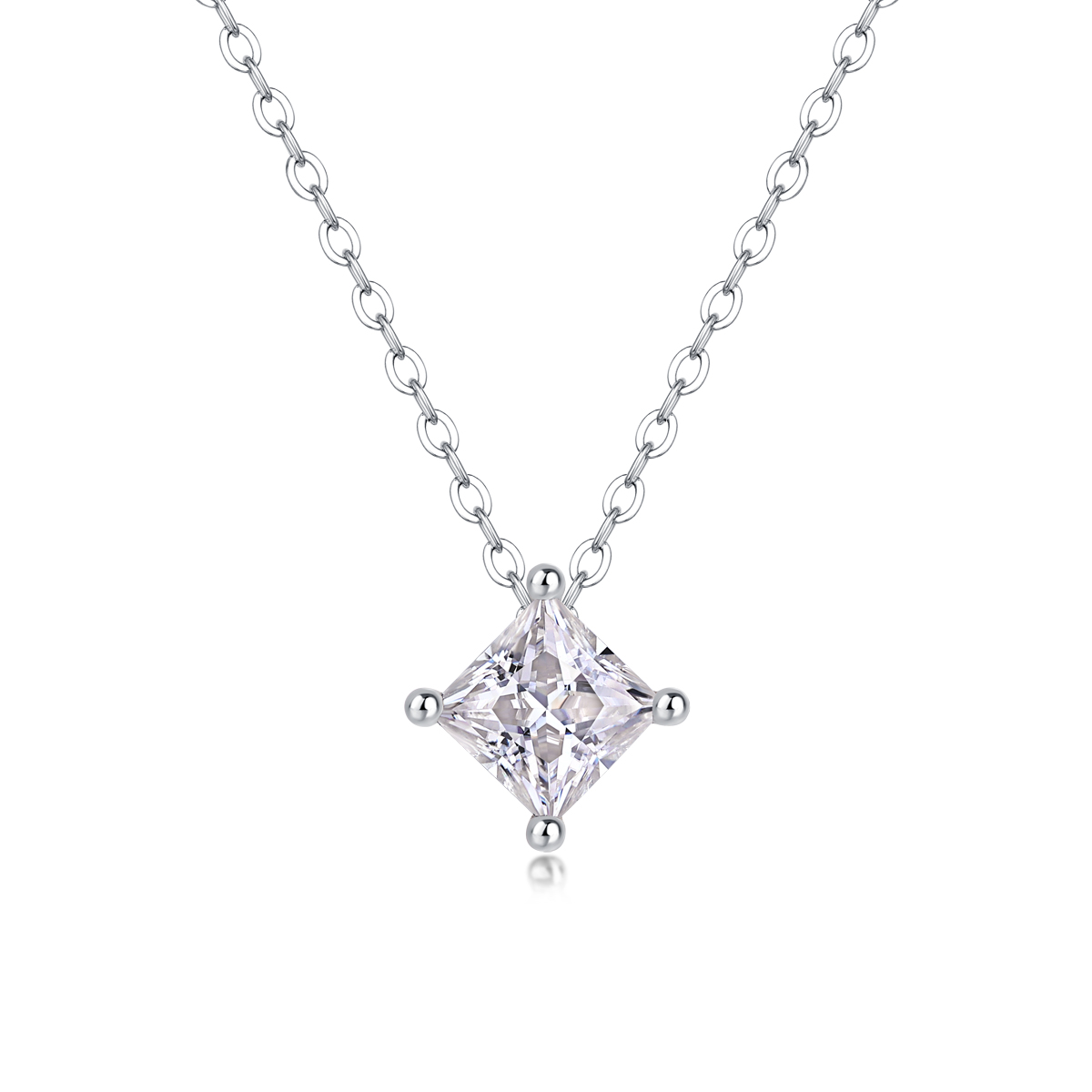
A solitaire gives you a different choice. It concentrates attention on a single stone, so deciding whether you like the outline, setting and size of that center carries more weight. A circular bezel frames a round stone with a defined edge. Prongs can give the same stone a different outline, particularly at a distance where individual tips blend into the silhouette. Try viewing the pendant from across a table. You might discover that the metal outline is what lets a small stone read clearly against your skin or your shirt.
Compare the dimensions that change the impression
For a station necklace, request individual stone dimensions, the distance between neighboring centers, and the distance from the first visible station to the last. If that final measurement follows the curve of the chain, ask the seller to say so. The curved distance along a necklace and the straight span across a display are different measurements. For a solitaire, ask for stone dimensions and the full width and height of the pendant. Include the bail if it hangs below the chain and contributes to the drop.
Imagine a necklace with five evenly spaced stations, each neighboring pair centered 25 millimeters apart along the chain. The first and fifth centers are four intervals apart, giving 100 millimeters along the chain. That number tells you the length of the decorated section between the two end centers. It does not predict exactly how wide the section will appear across your neck. A chain drawn into a deep V occupies a different horizontal span from one resting in a shallow curve. An on-body photograph is worth requesting for this reason.
| Question | Station necklace | Solitaire pendant |
|---|---|---|
| What draws the eye? | Spacing and repetition | The center outline and drop |
| Which measurements help? | Stone diameter, interval and decorated span | Stone size and complete pendant dimensions |
| What should a second photo show? | The side stations on a wearer | The bail and the side profile |
Do a fitting with paper dots and a favorite shirt
Wear a chain you already like over the shirt you expect to wear with the new necklace. Cut five small paper dots the size of the proposed stations, and one the size of the proposed solitaire. With the shirt laid flat, temporarily mark approximate positions on the fabric using removable paper or a light basting stitch if the fabric permits. Keep adhesive off the chain and skip adhesive altogether on delicate cloth. You are testing spacing and scale. A paper circle cannot tell you how a gem will reflect light.
Put the shirt on and look at the result from conversational distance. Take one picture straight on and another turned slightly to the side. For the solitaire, look at whether it seems centered in the visible opening. For the stations, pay attention to the outermost dots. If both disappear behind a collar, ask whether you still enjoy the pattern left by the middle three. If you do, there is little reason to object to decorative elements only you will see when the collar opens.
Change one thing at a time. Move the stations closer together while keeping their size fixed. Then restore the spacing and try slightly larger dots. It is easy to think you want larger stones when you actually want less empty chain between them. A jeweler who hears that distinction can show a better second option. If you shop online, compare the favorite arrangement with a ruler and save an ordinary phone photograph alongside the measurements.
Wear the necklace through a change of neckline
A scoop neck gives a spaced design room to draw its own curve. See whether the lowest station rests near the collar edge when you sit down. A design that looks centered while you stand can partly disappear behind the neckline when the fabric shifts. That may be of little consequence in a loose weekend shirt. It matters more if the necklace is meant for photographs in a particular dress and the missing station makes a symmetrical pattern look uneven.
A narrow V often exposes most of a solitaire and only the central stretch of a station necklace. The solitaire can emphasize the point of the opening. A spaced pattern can create a lighter effect, with a stone appearing on either side when the shirt moves. Try it with the top button done and undone on a button-down shirt. You may prefer different styles for those two positions even though you describe both outfits simply as wearing an open collar.
A plain sweater offers a continuous background, especially if its color contrasts with the chain. Here the whole visible rhythm of a station necklace can become the main detail of the outfit. A solitaire can do the same through a stronger single silhouette. Consider how the setting sits on the actual knit, and avoid drawing a delicate necklace across a raised seam during a fitting. A smooth top and a heavily textured one can produce quite different results even in the same color.
Watch what happens when the wearer moves
Ask the seller to show the entire front of the necklace after an ordinary head turn. In a station design, check whether the backs of the settings look different from the fronts and whether you like the necklace if one station turns. In a solitaire, watch whether the pendant hangs forward or at an angle and whether the chain slides freely where it meets the setting. A video of a hand lifting a pendant toward the lens may show craftsmanship beautifully and still tell you very little about its resting position.
If the necklace is adjustable, ask to see the shortest and longest wearable positions. An extender changes more than height. It can change where the decorated part sits relative to your collar and where the clasp rests at the back. A station near the side of the neck in the shorter position can move toward the front in another position, depending on the layout. A seller who photographs only the chain spread straight on a table leaves that question to your imagination.
Choose the role this piece will play
For a frequent traveler who wants one necklace to work with several shirts, consider the version that looks deliberate through the narrowest opening in the wardrobe. For someone who wears simple crew necks and wants more detail across the top, consider a stronger rhythm of stations. For a gift meant to recall a particular event, a single recognizable shape can have more personal meaning than a wider spread. If the recipient already wears a small solitaire daily, a station necklace might add a different piece they can rotate into their week.
Arrange two candidates side by side with their photographs at the same scale. Cover the prices for a moment and describe each in a sentence. “Seven points of light, with three visible inside my work shirt” is more useful than “more diamonds for the money,” particularly when the stones you are buying are moissanite. Once the description is clear, put the prices back and decide whether you would pay the difference for what is actually visible. Compare necklace styles by that visual role before narrowing the choice by setting and chain.
Frequently asked questions
Is a station necklace the same as a tennis necklace?
Look at the construction. A station necklace has noticeable intervals between decorative elements. A tennis necklace generally presents a continuous or nearly continuous row of settings. If a listing uses both descriptions, a full-length photograph will show whether you are buying separated points on a chain or a closely linked line of stones.
Does a station design have to be symmetrical?
No. An intentionally uneven design can place a cluster on one side or use different stone sizes. Ask for a front view in the intended wearing position and a picture of the complete chain. This makes it easier to distinguish deliberate asymmetry from a symmetrical necklace photographed with the clasp off center.
Which is easier to layer with another necklace?
Start with the necklace you already own. A fine station pattern can frame a longer pendant, while a simple solitaire can sit below a plain short chain. Check where the settings meet as you move and how close the lowest station sits to the second piece. Visible space matters more than a particular difference in chain lengths.
Can a solitaire be moved to another chain?
Some pendants slide off. Others are fixed to the chain or have an opening too small for the chain’s end fitting. Ask the seller to demonstrate removal and provide the usable inside dimensions of the bail. If the necklace is a gift, confirm whether its price includes the chain shown in the photograph.
What if two designs have the same total stone weight?
Ask how that total is distributed, then compare individual measurements. Several small stations spread the visual effect over a longer section, while a solitaire concentrates it at one point. Neither total weight nor stone count tells you which design will stand out most against the neckline and fabric you intend to wear.
What is the most useful request to send an online seller?
Ask for one unzoomed front photo at the stated chain length and one short video after the wearer turns slightly. Include the chain length and stone size you are considering. If there are multiple options on the listing, ask which variant is shown before using that image to decide between two different styles.